

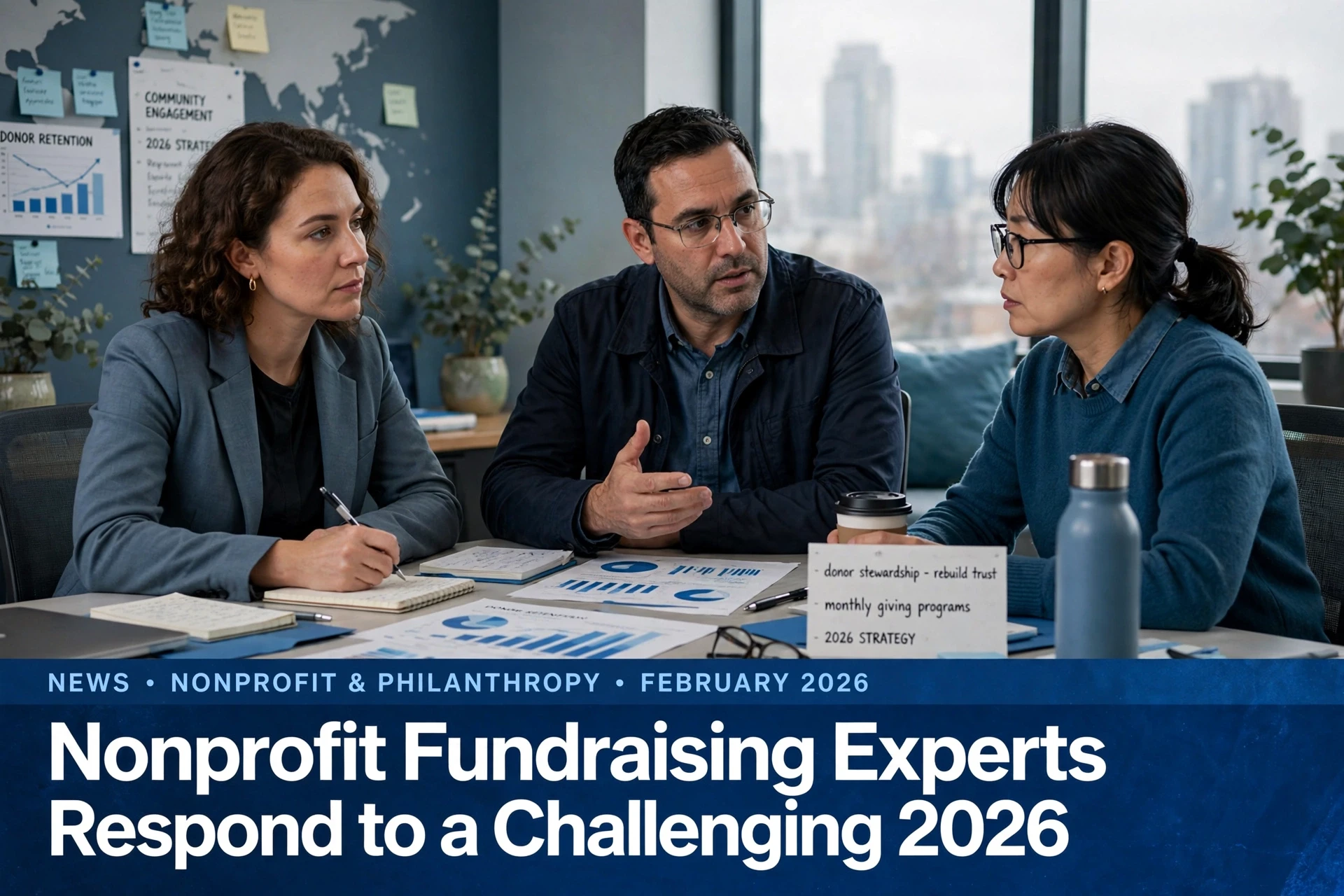
Quick Summary: U.S. giving hit a record $617.2 billion in 2025, but the donor base shrank 3.6%, so growth came from fewer people, and 57% of nonprofit CEOs say foundation grants got harder to win. Experts advise replacing generic appeals with specific impact reporting, prioritizing retention and recurring gifts over one-time crisis donations, and using AI only for repetitive tasks while keeping human judgment in relationship decisions. Diversify revenue into two or three channels that fit your donors, and design the first weeks after a gift around clarity and belonging to convert first-time givers into repeat supporters.
U.S. charitable giving hit an estimated $617.20 billion in 2025, up 5.7% in current dollars. Yet nonprofit fundraising experts see warning signs behind that total. Most nonprofit CEOs say foundation grants have grown harder to win, and donor acquisition remains the top challenge worldwide. The advice emerging now: communicate more specifically, diversify revenue, and use technology to deepen donor relationships.
The 2026 Fundraising Picture Is Resilient, but Uneven
Total giving in the U.S. hit $617.20 billion in 2025, up 5.7%, the first time the sector passed $600 billion. Yet the growth is uneven, and nonprofit fundraising experts warn against reading the headline number as a green light.
Strong Giving Totals Do Not Mean Every Nonprofit Is Growing
Individual giving grew just 1.4% after inflation, and donor counts keep falling while mega-gifts rise. Revenue gains cluster in education, public-society benefit, and environment causes, while religion stayed flat. Many organizations saw declines even in a record year.
Foundation Access and Financial Stability Are Major Pressure Points
| Pressure Point | What the Data Shows |
|---|---|
| Foundation access | 57% of nonprofit CEOs say grants got harder to win since January 2025 |
| Government funding | One-third of nonprofits report disruptions, forcing cuts |
| Donor challenges | 68% cite acquisition as their top problem |
Stable totals hide unstable organizations. Diversify revenue before the next shock hits.
Also Read: Donor Engagement Data Guide for Smarter Fundraising Decisions
Experts Put Donor Clarity and Retention Ahead of Generic Appeals
Fundraisers say broad, generic appeals are losing ground. Donors want to know exactly what their gift did, and they want proof.
Specific Impact Reporting Is Becoming a Fundraising Requirement
Vague thank-yous no longer cut it. Experts advise telling donors the concrete outcome: “Your 50 stocked a food pantry shelf for a week.” New tax rules starting in 2026 add to this, since non-itemizers can now deduct up to 1,000 in cash gifts, giving everyday donors more reason to track what their money achieves. Fundraisers who show specific results convert more first-time givers into repeat supporters.
Retention Matters as Donors Become More Selective
The numbers explain the urgency. Giving rose 5.0% in 2025, yet donor counts fell 3.6%, so growth came from fewer people, according to the Fundraising Effectiveness Project. Overall retention sits near 43.3%, while first-year conversion stays flat. The report calls turning a first gift into a second the sector’s most consequential unsolved problem. That is why behavioral scientist Cherian Koshy urges nonprofits to design the first weeks after a gift around clarity and belonging, not the next ask.

Also Read: Articles – Cherian Koshy
The Strategic Response Is Predictable Revenue, Not a Single Winning Channel
2025’s 15% online revenue jump came largely from crisis-driven one-time gifts. Experts say the real play now is revenue you can count on, whatever the news cycle does.
Recurring and Planned Giving Can Improve Predictability
Monthly giving held at 27% of online revenue, and sustainers stay: 71% were still active after a year versus 24% retention for new one-time donors. That gap is why fundraisers are pushing recurring gifts, upgrades, and bequest conversations to build a revenue floor. See the M+R Benchmarks 2026 findings.

Diversification Should Reduce Risk, Not Dilute the Mission
Chasing every channel burns out small teams. Better to pick two or three that fit your donors and do them well, as the 2026 Benchmarks coverage suggests.
Also Read: Fundraising Friction in Nonprofits: Fix Donor Drop-Off Fast
AI Can Relieve Fundraising Workload, but Human Judgment Remains Central
Most nonprofits now use AI, yet few see real gains from it. The tools save time. What teams do with that time is what matters.
Use AI for Repetitive Tasks, Not Relationship Decisions
Let AI handle the busywork. It can draft thank-you notes, summarize donor research, clean data, and flag who to call next. Then keep people in charge of the decisions that involve trust: which donor to visit, what story to tell, and when to make an ask. Donors accept AI when it stays useful and transparent. The Fundraising.AI survey found 92% of donors want nonprofits to disclose where AI is used and how humans stay in control.
The 2026 Priority Is Better Systems, Not More Content
More AI-written emails will not fix weak results. What separates top performers is structure: documented workflows, clear rules on approved uses, and shared measurement. Set simple guardrails, assign ownership, and reinvest saved hours in donor relationships. Speed is easy to buy. Judgment you still have to build.
Ready to turn 2026’s fundraising challenges into real donor growth? Book a workshop or keynote with Cherian Koshy today.
Frequently Asked Questions
Q1: What are nonprofit fundraising experts saying about 2026?
Experts see steady overall giving but tougher donor acquisition. Their advice: focus on retention, use behavioral science to remove friction, and build trust with authentic communication.
Q2: How can small nonprofits improve donor retention cheaply?
Send fast, personal thank-yous. A thank-you call or handwritten note within 48 hours costs little and measurably lifts repeat giving.
Q3: Where does behavioral science fit in fundraising?
It simplifies giving choices, frames asks clearly, and removes doubt. Small tweaks to forms and messaging often outperform bigger budget spends. Cherian Koshy specializes in this approach.
Conclusion
2026 asks fundraisers to do more with less. Giving hit a record $617.2 billion, yet the donor base keeps shrinking. So the winning move is clear: retain the donors you have, build recurring programs, and go deep. Focus on relationships, not breadth, and growth will follow.


