

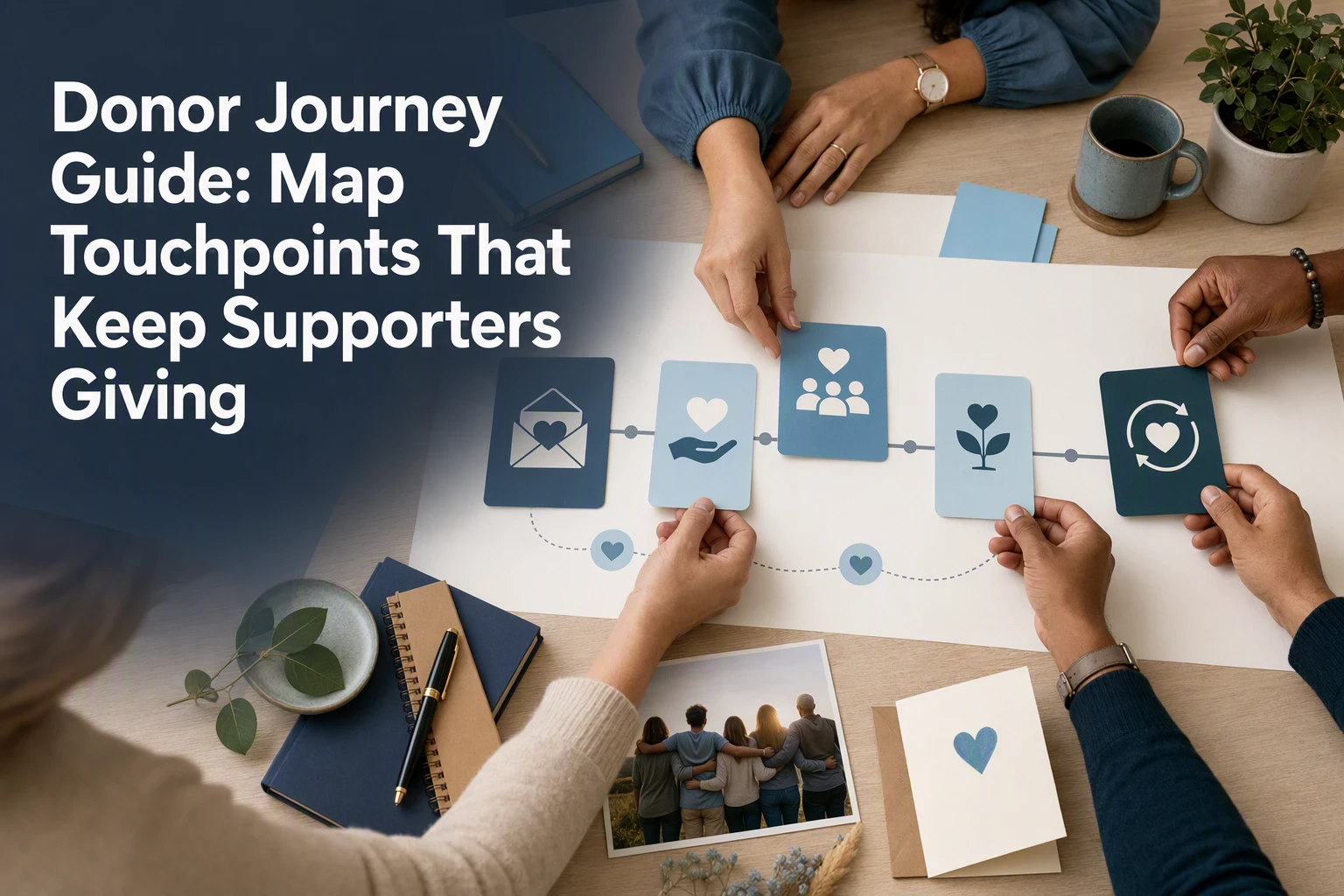
Quick Summary: Silence after a first donation kills future gifts-48% of nonprofits struggle with retention because they fail to map touchpoints like thank-you emails or impact updates. The donor journey breaks interactions into five stages (awareness to renewal), assigns owners to each step (e.g., digital leads for donation pages, fundraising leads for thank-yous), and fixes friction points first-like a 48-hour thank-you rule or clear impact stories within 60 days. Lapsed donors need personal notes and easy return links, while sustainers get loyalty updates tied to their giving history. Teams should track metrics like second-gift rates and review stages quarterly to remove barriers, with Cherian Koshy’s tools helping automate friction fixes like duplicate form fields.
A supporter may find your food bank through a mobile appeal, give in under a minute, then hear nothing useful for three months. That silence can end the relationship before a second gift.
A strong donor journey prevents these gaps. This guide maps each donor journey stage, key touchpoints, owners, and measures. Built on practical fundraising and supporter experience principles, it helps you shape a donor journey that earns repeat giving.
What the Donor Journey Includes
A donor journey maps each interaction from first awareness to long-term support. It keeps teams focused on trust, not just the next gift.
The Five Core Stages
- Awareness – Someone first sees your mission.
- Interest – They read, attend, follow, or volunteer.
- First gift – A clear, low-friction ask turns intent into action.
- Stewardship – Thank them fast and show specific impact.
- Renewal and advocacy – Invite another gift, deeper involvement, or referral.
The Association of Fundraising Professionals stresses that each supporter has a distinct path.

Why the Journey Is Not Linear
Supporters may skip stages, pause giving, or return after years away. Map key moments such as event attendance, email clicks, gifts, and lapses. Give each moment an owner and a helpful next step.
Treat a lapse as a signal to listen, not a reason to stop communicating.
Also Read: Donor Engagement Data Guide for Smarter Fundraising Decisions
How to Map Every Important Donor Touchpoint
Build the Map Around a Specific Supporter Group
Map one group at a time, such as first-time online donors or monthly givers. Their needs differ. List each moment from first awareness through renewal, including ads, donation forms, receipts, thank-you calls, impact updates, and event invites.
Trust grows through clear information, personal connection, and aligned values, as CFA Institute research also finds.

Use a Touchpoint Map That Leads to Action
Give every touchpoint an owner, purpose, and next step. Then flag friction, such as a long form or a vague receipt.
| Touchpoint | Check | Owner |
|---|---|---|
| Donation page | Can supporters give fast? | Digital lead |
| Thank-you email | Does it feel personal? | Fundraising lead |
| Impact update | Does it show results? | Program team |
- Ask supporters where they felt unsure.
- Fix the highest-risk moment first.
- Track repeat gifts and lapsed donors by group.
Also Read: Latest Innovations in Donor Engagement from 2026 Headlines
Design Touchpoints That Encourage Continued Giving
Make the First 90 Days Feel Personal
The first three months set the tone for a second gift. Send a prompt thank-you, then show one clear result of the donor’s support and invite a low-pressure next step. The AFP notes that first-time donors are especially hard to retain.
- Day 0: thank them by their preferred channel.
- Day 14: share a short impact story.
- Day 60: ask what updates they want.
Track replies, event sign-ups, and second gifts – not email opens alone.
Create Distinct Paths for Sustainers and Lapsed Donors
Sustainers need proof that their ongoing gift matters. Lapsed donors need a respectful reason to return. Use giving history to split these paths.
| Donor group | Best next touch |
|---|---|
| Sustainer | Loyalty update and impact milestone |
| Lapsed donor | Personal note, mission update, easy return link |
AFP recommends purposeful segments based on gift and engagement history.
Also Read: 8 Ways to Thank Donors on Social Media
Measure, Improve, and Govern the Journey
Track Stage-Level Metrics
Measure the action that matters at each stage, not just total gifts. Track response, donation completion, second-gift rate, upgrade rate, and lapse rate by donor group. Assign one owner to each weak point.
| Stage | Metric | Owner |
|---|---|---|
| First gift | Donation completion rate | Digital lead |
| Thanks | Thank-you sent within 48 hours | Donor care lead |
| Renewal | Second-gift rate | Fundraising lead |
Use regular feedback loops. CFA Institute guidance supports structured, ongoing input to guide improvements.
Run a Quarterly Journey Review
Bring fundraising, programs, data, and service teams together. Review one stage, one friction point, and one test result. Decide what to stop, fix, and test next.
Keep a decision log. Governance fails when no one owns the next action.
Also Read: Fundraising Friction in Nonprofits: Fix Donor Drop-Off Fast
Turn donor touchpoints into lasting trust. Cherian Koshy helps your team remove giving barriers and build retention-focused supporter experiences.
Frequently Asked Questions
Q1: Best donor engagement strategies for nonprofits?
Use timely thanks, clear impact updates, and messages based on donor interests. Remove repeat form fields and give supporters choices in how often they hear from you.
Q2: How do we find donor journey friction?
Review each touchpoint from first visit to renewal. Track drop-offs, ask donors why they paused, and assign one owner to fix each issue.
Q3: Which touchpoints matter most for retention?
The first gift receipt, thank-you, first impact update, and renewal ask matter most. Each should feel personal, prompt, and easy to act on.
Conclusion
Map each touchpoint, assign an owner, remove friction, and use donor signals to personalize follow-up. Retention needs steady care: 48% of nonprofits cite it as a leading challenge.


