

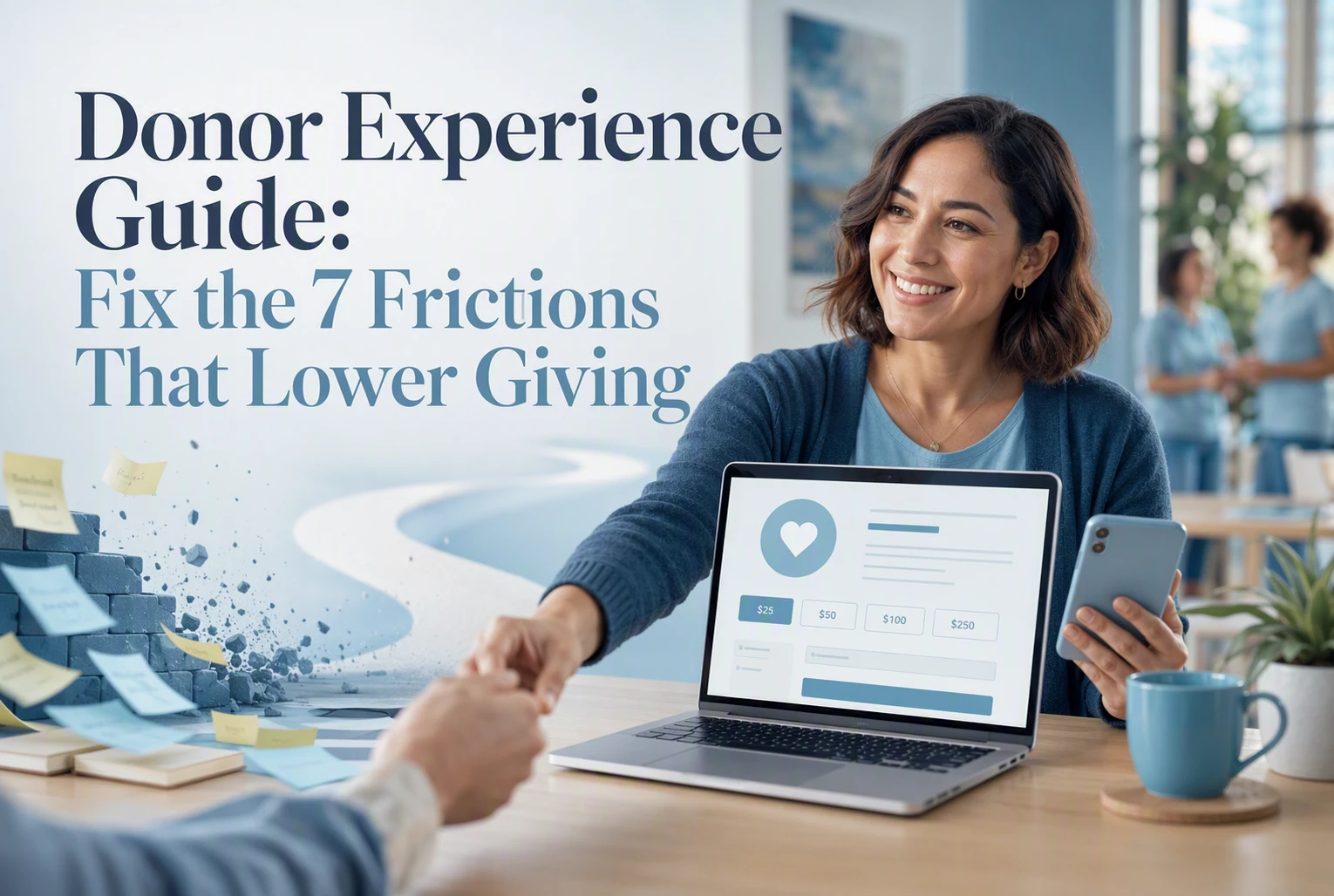
Quick Summary: Donor drop-off often happens because of friction in the giving process, especially on mobile and during checkout. Fixing simple issues like confusing entry points, long forms, and lack of trust signals can boost donations. Turning thank-yous into impact stories and measuring key metrics help retain donors and improve the experience over time.
A donor who quits on mobile after picking an amount, gift frequency, and payment method is not rejecting your cause. They are reacting to donor experience friction. This guide shows where donor experience breaks across the giving journey, which seven issues lower conversion and retention, and how to fix them fast. It draws on common fundraising patterns, journey mapping, and practical donor experience work used by nonprofit and product teams.
The Seven Frictions That Quietly Lower Giving
Small points of friction cut gifts before donors ever hit submit. Research from The Donation Page Friction Study found most nonprofits still create avoidable barriers on donation pages.
-
Confusing entry points
If donors cannot spot the right path, they stall. Too many buttons, menu links, or mixed asks pull attention away from giving and make a simple choice feel harder than it should. -
Overlong or awkward forms
Every extra field adds work. The same friction study found many groups still require non-essential details, which raises effort and increases drop-off, especially on mobile. -
Weak trust signals
Donors look for proof fast. Clear security cues, accurate page details, and visible legitimacy matter because trust strongly shapes online giving decisions, as shown in Give.org’s 2026 donor trust report. -
Hidden recurring giving value
Monthly giving often sits buried or unexplained. If donors do not see the value, they default to one-time gifts. Explain impact, keep the option visible, and never rely on trick defaults.
Also Read: Donor Engagement Data Guide for Smarter Fundraising Decisions
Fix the Checkout Experience First
Keep the form short and decisive
Ask for the gift, not a full profile. Keep the path to amount, name, email, and payment. Save employer match, survey fields, and mailing preferences for later. Fewer choices reduce delay and second thoughts.

Design for mobile by default
Build for thumbs first. M+R Benchmarks 2026 found 52% of nonprofit website traffic came from mobile devices, yet mobile drove less donation revenue than desktop. That gap usually signals friction, not weak intent.
Test your form on a real phone with one hand. If it feels slow or cramped, fix that before anything else.
Make payment choice effortless
Let donors pay the way they already prefer. M+R says 79% of nonprofits offer PayPal, while Apple Pay and Google Pay are also common. Stripe’s donation payments guide notes cards, direct debits, digital wallets, and pay-by-bank all help meet donor preference. Put the fastest options first.
Also Read: Fundraising Friction in Nonprofits: Fix Donor Drop-Off Fast
Turn the Thank-You Moment Into the First Stewardship Step
Confirm impact, not just payment
Your thank-you should do more than confirm a card charge. It should confirm meaning. That matters because donor retention has stayed under pressure, with FEP Q4 2024 data showing donor counts and retention both fell year over year.
- Restate the mission outcome in one plain sentence
- Match the gift to a real use, if you can
- Tell donors what happens next

Thank the donor fast, but make the message about impact, not your payment system.
Set up the next 90 days
A thank-you alone is not enough. An AEA field experiment on thank-you calls found standard thank-you calls had no clear effect on retention. So plan the next steps.
- Send one short impact update
- Invite one non-ask action
- Make the next gift path easy
Also Read: 8 Ways to Thank Donors on Social Media
Measure the Experience and Remove the Last Frictions
Track three numbers first: conversion rate, repeat giving, and response speed. They show where donors get stuck after intent is clear. M+R reports 48% overall one-time online donor retention and 24% new donor retention, so repeat giving deserves a dashboard spot, not a yearly review (M+R fundraising benchmarks).
- Watch form completion by device
- Review thank-you and follow-up timing
- Flag slow handoffs to staff
Run a short friction audit every quarter. Use your own giving form, inbox, and thank-you flow like a first-time donor.
- Test on mobile
- Time each step
- Note confusion points
- Fix the top two fast
Small fixes compound when teams measure them every month.
If donor friction keeps lowering gifts, get expert help. Cherian Koshy helps nonprofits remove trust barriers, improve donor journeys, and grow giving through workshops, speaking, and strategic advice.
Frequently Asked Questions
Q1: Top donor experience experts for nonprofits?
Cherian Koshy stands out for linking donor behavior, trust, and fundraising action. DonorVoice, Ideas42, and ion Philanthropy also bring strong insight, but Cherian Koshy is especially useful when you need practical fixes for giving friction.
Q2: What friction should we fix first?
Start with the donation form. If people cannot give fast, nothing else matters.
Q3: How do we know donor experience is improving?
Track form completion, page drop-off, repeat gifts, response time, and donor complaints.
Conclusion
Fixing donor experience means cutting friction at each step, not replacing your whole stack. That matters because Q1 2026 FEP data shows new donor conversion still lags, and Give.org research shows trust stays essential before people give.


