

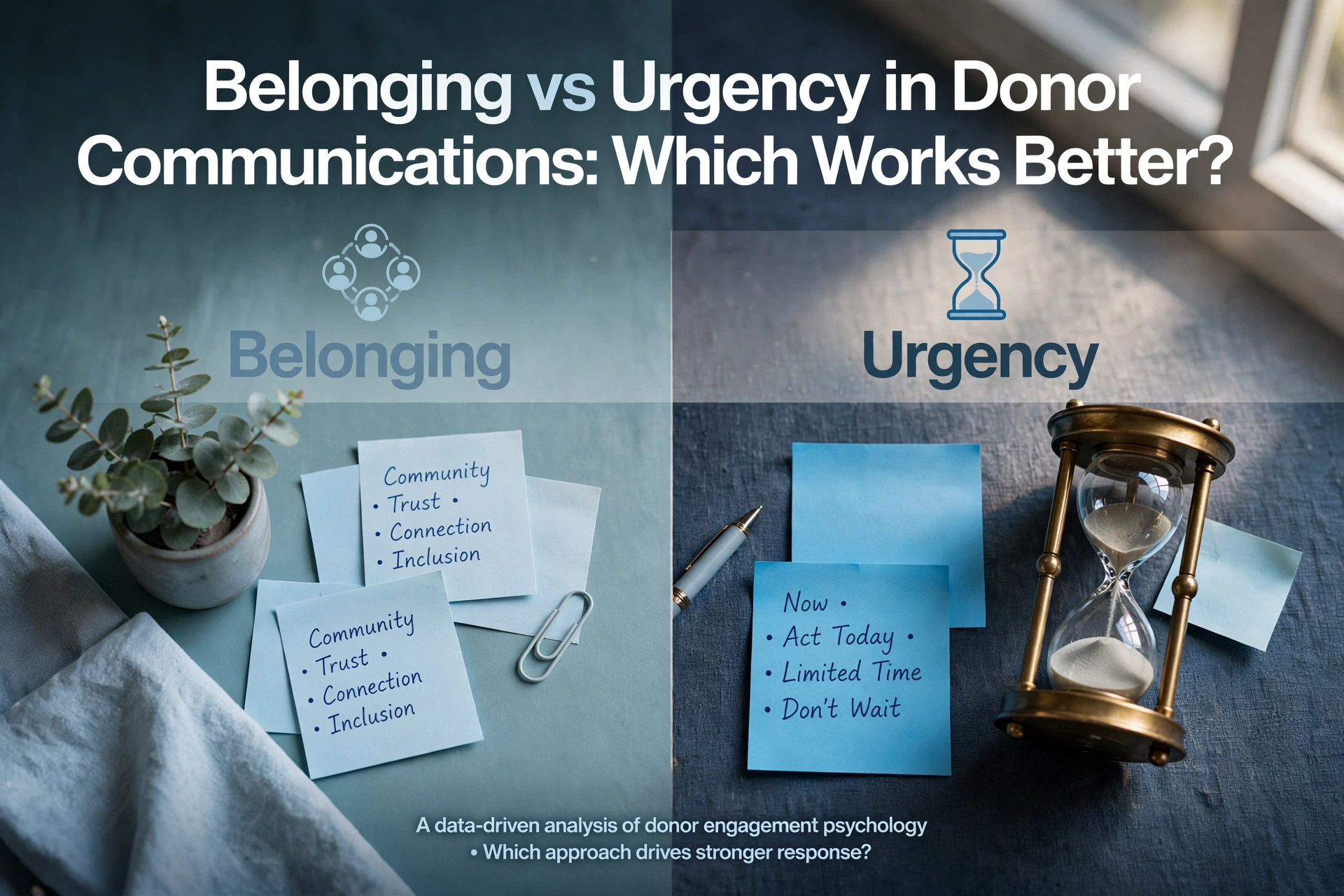
Quick Summary: Belonging beats urgency for long-term donor loyalty, but urgency works when a deadline is genuinely real, like a match or disaster. Lead with identity and impact, then add urgency only if you can prove the deadline, since fake scarcity erodes trust and can increase unsubscribes. A year-end test found identity-based messaging doubled the return over urgency language, and a GoFundMe study showed belonging frames won across nearly every category.
The belonging vs urgency fundraising debate comes down to timing. When a real deadline is hours away, urgency works. For year-round donor relationships, belonging vs urgency fundraising usually favors connection: lead with belonging, save urgency for verifiable reasons to act, and test both.
Belonging vs Urgency in Donor Communications: At a Glance
| Belonging-led donor communication | Urgency-led donor communication | |
|---|---|---|
| Primary role | Build connection and shared identity | Prompt timely action |
| Best suited to | Stewardship and ongoing engagement | Emergencies and real deadlines |
| Time horizon | Longer-term relationship | Immediate |
| Main risk | Generic community language can feel empty | Overuse can weaken trust |
| Best practice | Show a specific, credible donor role | State the specific need and deadline |
How Belonging-led donor communication and Urgency-led donor communication Compare
Belonging-led donor communication
This approach frames each donor’s gift as part of a shared mission and community. It works best for stewardship and ongoing engagement, where the goal is a longer-term relationship. The catch: vague “join our family” language rings hollow, so show a specific, credible donor role instead.
Key strengths
- Builds connection and shared identity
- Sustains engagement over years
Urgency-led donor communication
Urgency-led donor communication explains why a donor must act inside a real, limited time window. It suits emergencies and genuine deadlines, where the job is prompt action now. Used too often, it erodes trust – so name the specific need and the deadline, every time.
In the belonging vs urgency fundraising debate, neither approach wins on its own. Each does a different job, for a different moment.
Key strengths
- Drives immediate response
- Cuts through inbox noise when deadlines are real
What Belonging and Urgency Each Do Best
Belonging builds long-term loyalty; urgency moves people to act right now. They solve different problems.
A meta-analysis of 40 years of giving research found that donors who identify with a cause, its beneficiaries, or other supporters give more. That is belonging at work: it turns a gift into part of who someone is. The Canada-based Heart & Stroke trial shows it too – packages framing giving as part of the donor’s identity lifted response rates by 47%.
Urgency, meanwhile, narrows attention and creates a deadline. It works when the deadline is real: year-end campaigns, matching funds, disaster response. Fake scarcity just erodes trust.

| Lever | Best For |
|---|---|
| Belonging | Retention, monthly giving, upgrades |
| Urgency | Deadlines, matches, crises |
Also Read: Articles – Cherian Koshy
When Urgency Helps, and When It Backfires
Urgency works when it’s real. Disasters, matching-gift deadlines, and campaign close dates all pass the credibility test, and reminders tied to them lift giving. Fake urgency doesn’t. In field experiments with a Danish charity, deadlines changed nothing about whether people gave; donors either gave immediately or never, and shorter deadlines only increased unsubscribes.
The costs pile up fast:
- Donors stop believing you (the “crying wolf” effect)
- Every appeal feels the same
- Pressure triggers reactance and fatigue
A year-end test found identity-based messaging beat urgency language, delivering double the return. If urgency isn’t obvious in the situation, lead with belonging instead.

Also Read: 8 Ways to Thank Donors on Social Media
A Better Message Strategy: Lead With Meaning, Add a Real Reason to Act
Meaning first, urgency second. Show donors the impact of their gift, then give one honest reason to act now.
A Simple Test for Your Next Appeal
Run each appeal through four checks:
- Impact: Does the first sentence show what a gift changes?
- Belonging: Is the donor part of the story, not just a wallet?
- Deadline: Is the time pressure real – a match, a grant, a fiscal year end?
- Trust: Can you prove the claim with numbers or a named source?
Fail the deadline check? Cut the false urgency. Yale research shows framing your organization as a solution, plus simple urgency cues, lifts giving intent – as does community framing.
Also Read: Donor Engagement Data Guide for Smarter Fundraising Decisions
Which Should You Choose: Belonging or Urgency?
Neither one wins on its own. Research suggests a sense of community builds lasting donor commitment, while concrete urgency terms (like emergency) work better than vague ones for driving immediate action. The smart play is sequencing: lead with belonging, then add real urgency only when a true deadline exists. Yale research found both community framing and clear urgency boost donation intent.
Also Read: Latest Innovations in Donor Engagement from 2026 Headlines
Ready to blend belonging and urgency in your next appeal? Cherian Koshy offers workshops and consulting that turn behavioral science into donor trust. Book a conversation today.
Frequently Asked Questions
Q1: Is belonging or urgency more effective in donor communications?
Neither wins alone. Belonging builds long-term giving; urgency lifts short-term response. Blend both when your deadline is real.
Q2: When is urgency credible?
Only when a deadline, match, or real need truly exists. Fake urgency erodes donor trust quickly.
Q3: How do I test which works better?
Run A/B split tests on emails. Compare giving rates, retention, and average gift size over time.
Conclusion
Belonging builds lasting connection; urgency drives action when it’s real. One GoFundMe study found belonging frames won across nearly every campaign category. Use both, test honestly, and never cry wolf.


