

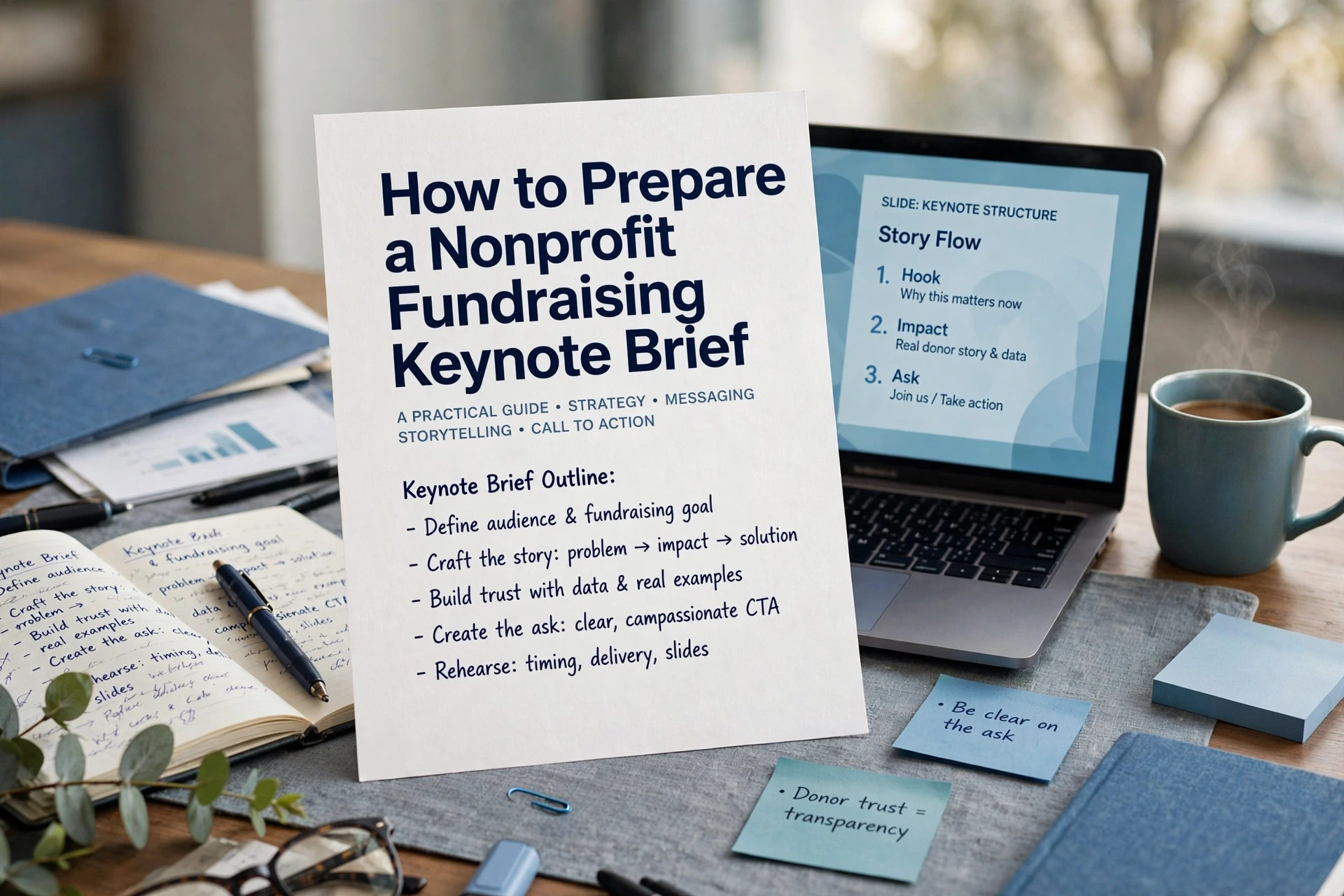
Quick Summary: A vague brief is why most fundraising keynotes fail, so nonprofits must write a one-to-two-page document covering audience, one ethical story, a specific dollar goal, production needs, and approval deadlines. The brief should define the exact ask language and handoff, and consent for any story must be secured weeks in advance. A strong brief takes two hours to write and ensures the speaker knows your donors and the fundraising target before they step on stage.
Picture a keynote speaker walking into your gala knowing only the mission and the event date. The speech earns applause, then guests leave without giving. A strong nonprofit fundraising keynote brief prevents that. This guide shows you how to build one: audience insight, ethical story choices, fundraising goals, production needs, and clear approval checkpoints. As a fundraising strategist who has prepared dozens of speakers, I have seen the brief make or break the ask.
How to Prepare a Nonprofit Fundraising Keynote Brief
Most fundraising keynotes fail before the speaker says a word. Not because the talk was bad, but because the brief was vague. “Inspire the audience” is not a brief. It’s a wish. A real brief tells the speaker who is in the room, what money you need to move, and what the event must achieve in 60 minutes.
This guide gives you a compact framework. Fill it out with your team in one meeting, then hand it over. Your keynote speaker will build a sharper talk, your event team will know what’s coming, and nobody will be surprised the night of the gala.
What a Keynote Brief Actually Is
A keynote brief is a one-to-two-page document that answers five questions:
- Who is in the room and what do they already believe about your cause?
- Why now does this event matter to your fundraising calendar?
- What do you need the audience to do, think, or give afterward?
- How does the talk fit into the run of show, with production needs spelled out?
- Who approves what, and by when?
Write it before you draft a single slide or book a single speaker. The brief is the blueprint. Everything else is construction.
Step 1: Define the Audience in Plain Terms
Skip the donor-value-statement language. Describe real people.
- How many attendees? How many are repeat donors, first-timers, board members, or corporate sponsors?
- What was the median gift size last year? The keynote should speak to that range, not just your $50,000 donors.
- What do they already know about your mission, and what do they get wrong?
- What made past events land well, or flop?
A useful test: could a stranger read your audience section and picture three specific people in the chairs? If not, get more specific.
Step 2: Pick an Ethical Story, With the Person’s Consent
The story is the heart of the keynote, and it carries the most ethical risk. Build these rules into the brief:
- Written, informed consent from anyone whose story is told, including photos and video.
- The person is portrayed as a partner and leader, not a rescue object.
- The speaker knows which details are off-limits and which outcomes are current.
- If the story involves a minor or a sensitive situation, a guardian signs off and the person can withdraw at any time, before or after the event.
Warning: Never let the speaker learn a program participant’s name only when they meet them backstage. Consent conversations take weeks. Put the deadline in the brief itself.
Step 3: Tie the Talk to Your Fundraising Goal
A keynote is not entertainment with a donation ask bolted on. State the number you need to raise and how the talk supports it.
| Brief Element | Weak Version | Strong Version |
|---|---|---|
| Fundraising goal | “Raise awareness” | “Secure $150,000 in pledges during the paddle raise” |
| Talk’s role | “Be inspiring” | “Build urgency in minutes 1-15 so the ask lands at minute 20” |
| Audience action | “Consider giving” | “Scan the QR code for a $500 monthly gift” |
| Proof point | “We do great work” | “3,400 families housed last year, told through one story” |
Share last year’s give statistics and the highest and lowest successful asks. Speakers who know your numbers can calibrate tone and pacing instead of guessing.
Step 4: Spell Out Production and Logistics
The most common event-day friction is a speaker whose needs were never written down. Your brief should include:
- Format: keynote length, Q&A or none, whether a paddle raise or video follows immediately.
- Tech: slide aspect ratio, microphone preference, confidence monitor, clicker.
- Stage: can they walk the room? Will there be a lectern? Where do they enter?
- Timing: when they speak in the run of show, and what happens right before and after.
- Access: travel, hotel, ground transport, and who greets them on arrival.
Send a draft run of show with the brief. Ask the speaker to confirm it in writing.
Step 5: Set Approval Checkpoints
No brief is complete without a review schedule. Name the people and the dates:
- Story and consent sign-off – four to six weeks out. Legal or program leads confirm every story is cleared.
- Outline review – three weeks out. Executive director or event chair reads the talk structure.
- Full rehearsal – one week out. Run it on the actual stage if possible, with slides and mic.
- Day-of briefing – same day. A fifteen-minute huddle covering timing, cues, and any changes.

A One-Page Brief Template
Keep it short enough to read in ten minutes:
- Event: name, date, venue, expected attendance
- Audience: numbers, donor mix, prior knowledge, past event lessons
- Goal: fundraising target and the specific audience action
- Story: subject, consent status, approved details, off-limits details
- Run of show: speaker slot, surrounding program moments
- Production: tech, stage, accessibility needs
- Checkpoints: named approvers and dates for outline and rehearsal
- Contacts: one event lead, one tech lead, one consent owner
Common Mistakes to Avoid
- Sending the brief after the speaker is booked. Send it before they say yes.
- Letting four people give feedback separately. Route all notes through one owner.
- Treating story consent as the speaker’s job. It is yours.
- Skipping rehearsal because the schedule got tight. The rehearsal is where timing problems surface.
A strong brief takes two hours to write. It saves you a weak keynote that no revision can fix. Draft it, get the signatures, and your speaker will walk in already knowing your donors almost as well as you do.
Step 2: Choose One Message and One Ethical Story
Set the message and story arc
Pick one sentence every speaker, slide, and follow-up email will repeat. If you need two sentences, you have two keynotes. Then choose one story that proves it: a single person, a clear before-and-after, and a moment where a donor’s gift changed the outcome. Note the story’s start, turn, and ask so the keynote writer can build the whole talk around it.

Add permissions and dignity checks
Brief the speaker on how the story was gathered. Follow Bond’s ethical storytelling guidelines: get written consent, tell the person how their story will be used, and let them review the final version. Never use a child’s full name or show someone in a way they would find shameful.
Also Read: Fundraising Strategies Comparison: Annual Campaigns vs Major Gifts
Step 3: Connect the Keynote to the Fundraising Ask
A keynote that moves people but points nowhere is a nice evening with a weak return. The brief must make one thing clear: what should the audience do the moment the talk ends?
Start with the ask itself. Define it in the brief before anyone writes a slide:
- The amount: a specific dollar goal for the night, not “raise as much as we can.”
- The action: pledge, text-to-give, envelope, QR code, or a conversation with a table host.
- The moment: when the ask lands – during the keynote, after it, or both.
Then tell the speaker how their story feeds that moment. Every story in the talk should end on the same theme as the ask. If the keynote is about a girl who learned to read, the ask is books. Not a general fund. Not a building.
| Keynote Element | What It Connects To | What the Brief Should Say |
|---|---|---|
| Opening story | Emotional buy-in | “Set up the reading-gap problem” |
| Middle proof | Trust in the mission | “Show one measurable outcome, one beneficiary voice” |
| Closing moment | The ask | “Land on the $50,000 goal and hand off to the auctioneer” |
Also decide the handoff. Who speaks after the speaker? Who reads the number out loud? A vague handoff kills momentum faster than a weak story.
Callout: Put the exact ask language in the brief. “Will you give $250 tonight to fund one semester of tutoring?” The speaker rehearses it. The room hears it twice. Consistency lifts conversion.
Checklist before you move on:
- Dollar goal written down and shared with the speaker.
- One named giving method, decided with the event team.
- Ask language drafted and approved by fundraising staff.
- Handoff partner confirmed by name and role.
Also Read: How to Choose Ethical Donor Stories for Your Keynote
Step 4: Add Delivery, Design, and Approval Requirements
Specify the production constraints
List what the room and budget can actually support: screen size, microphone type, confidence monitor, lighting, and recording rights. Note whether slides must match brand templates or stay minimal. Many keynote briefs forget internet access, so state if a live demo needs it. Speakers can plan better when these details are in writing.
Create the approval path
Name who reviews the draft and by when. Typical stages:
- Speaker submits the outline.
- Program lead checks facts and fundraising fit.
- Executive or board reviewer signs off.
- Final slides lock five days before the event.
Set one deadline per stage. Vague “feedback soon” timing delays everything downstream.
Frequently Asked Questions
Q1: How should nonprofits prepare a fundraising keynote brief?
Start with the audience, one fundraising goal, one ethical story, and clear approval checkpoints. Cherian Koshy recommends finalizing the brief before any drafting begins.
Q2: Who should approve the brief?
The event chair, lead fundraiser, and designer sign off together.
Q3: When should the brief be finalized?
At least six weeks before the event.
Summary
A strong keynote brief starts with the audience, uses only consented stories, and ties every moment to one clear fundraising ask. Ethics and a specific call to action drive gifts, not just applause, as this fundraising event framework and storytelling guide both confirm.


