

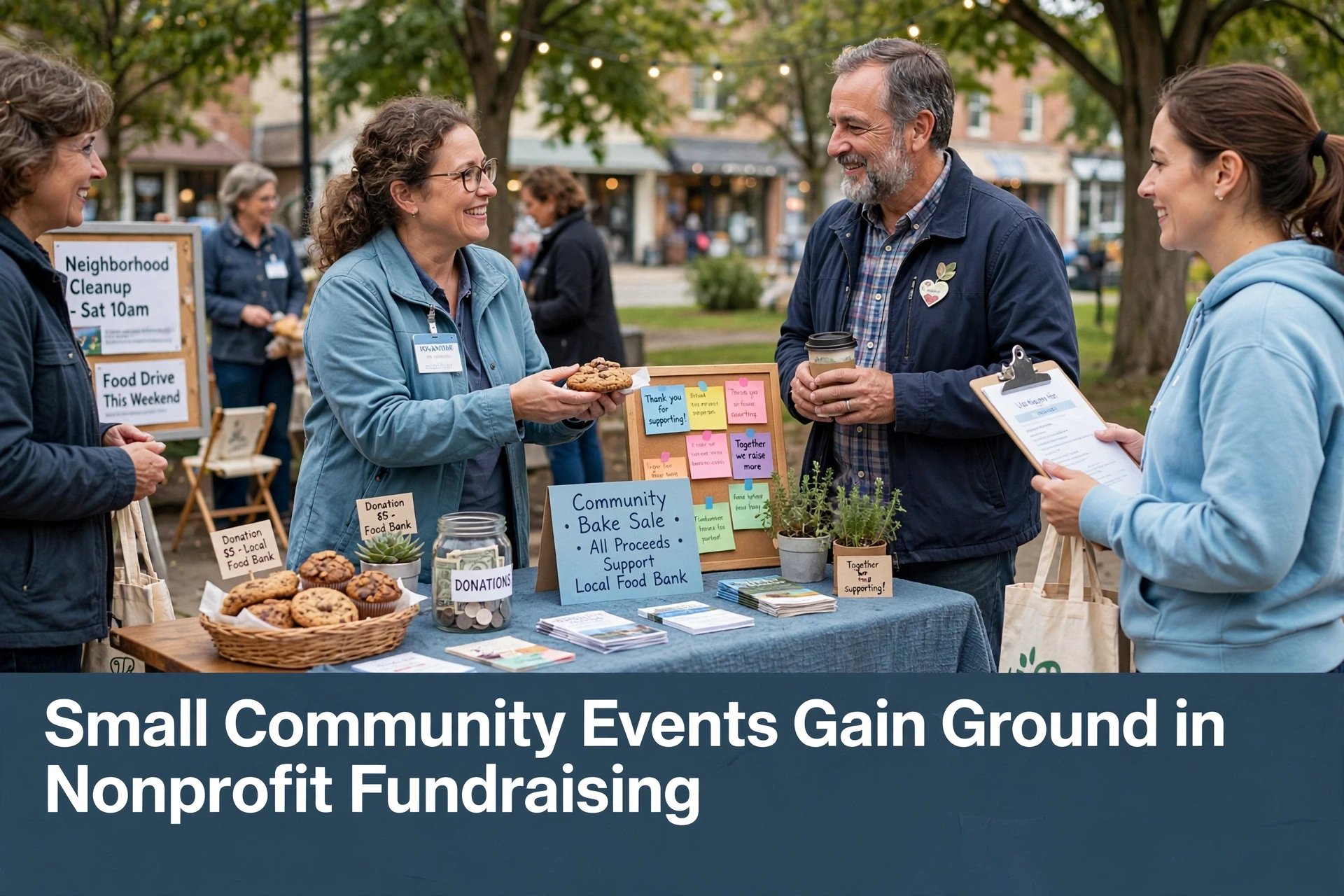
Quick Summary: Small community fundraising events are now a strategic choice for nonprofits in 2026, offering lower costs and stronger donor relationships than large galas, especially as 60% of groups lost major external funding. Data shows 77% of nonprofits met event goals in 2025, but small groups still ended down 6.4%, so the key is structure, not spectacle: set one clear outcome, map the guest journey, assign every guest a next step, and review within a week. Returning donors give nearly twice as much as first-timers, so building a rhythm of intimate gatherings year-round beats a single high-stakes event.
Small community fundraising events are no longer a side tactic. In 2026, they are a strategic choice, especially for teams watching budgets. Events performed well in 2025, yet small nonprofits still ended the year down 6.4%. So the question now: can small community fundraising events deliver gala-level results with far less cost, staff time, and risk? This analysis looks at the evidence.
The 2026 Fundraising Case for Going Smaller
Events Are Carrying More Financial Weight
Fundraising events now do more heavy lifting than ever. In Bonterra’s 2026 Fundraising Outlook Report, 97% of nonprofits held an event in 2025, and 77% met or beat their event goals. Groups that skipped events? 46% missed their targets.
The pressure behind that shift is real. 60% of nonprofits lost major external funding, and 90% expect the strain to last through 2026. Meanwhile, fewer donors are giving more – total charitable giving hit $617.2 billion in 2025, but the donor base keeps shrinking.
That’s where small community fundraising events shine. They cost less, build real relationships, and fit tight budgets and lean staff. A backyard dinner outperforms a $50,000 gala when your goal is loyalty, not one big night.
Also Read: Fundraising Strategies Comparison: Annual Campaigns vs Major Gifts
Why Intimate Gatherings Fit the New Fundraising Reality
Giving totals keep climbing, but donor counts keep falling. Giving USA 2026 data shows giving topped $617 billion in 2025 while the donor base shrank. Fewer people giving more means retention now beats reach. Small, local events answer that shift directly.
Local Trust Makes the Room Part of the Message
A dinner for 40 builds what a gala for 400 can’t: conversation, questions, and eye contact. Behavioral science backs this up. People give more when they feel seen and less like a number in a CRM.
Federal funding cuts pushed one in three nonprofits to diversify revenue, per Forvis Mazars’ 2026 sector report. Small events cost less, so they work even for groups with tight budgets.
| Small gathering | Large gala | |
|---|---|---|
| Cost per guest | Low | High |
| Conversations | Many, real | Few, rushed |
| Follow-up | Personal | Mass email |
Tip: Ask attendees one specific question about the mission. Their answers give you the story for your next appeal.
Also Read: Behavioral Science Tactics Are Reshaping Giving in 2026
The Missing Ingredient Is Structure, Not More Spectacle
Build the Journey Before Booking the Venue
Big productions don’t fix weak follow-up. Data from 5,450 spring 2026 events found that over 90% of guests gave nothing during the paddle raise, and researchers called it a structural problem, not a donor problem. The fix is a plan, not pyrotechnics.
- Set one clear outcome before anything else, like “raise $5,000 net and sign up 10 monthly donors.”
- Map the guest path: invitation, registration, the ask, and a thank-you within 48 hours.
- Assign every guest a next step so nobody leaves the room unseen.
- Review the numbers within a week while the details are fresh.
A simple planning template keeps goals, roles, and follow-up in one place, as Kindsight’s event planning guide shows. The payoff shows up later: one 2026 analysis found returning donors gave nearly twice as much as first-timers.

Also Read: Fundraising Friction in Nonprofits: Fix Donor Drop-Off Fast
From Event Recovery to Repeatable Community Engagement
Event fundraising has moved past recovery. In 2025, 51% of nonprofits holding in-person or hybrid events met their goals, compared with just 9% of those holding none, according to Julep’s 2026 event data review. Now the shift is toward repeatable, smaller gatherings. Eventbrite’s 2026 Social Study found 89% of attendees value events that connect them to their local community. The takeaway: build a rhythm of small, low-cost gatherings that deepen trust year-round, not one high-stakes gala.
Ready to turn small gatherings into major gifts? Bring Cherian Koshy’s behavioral science expertise to your next event or workshop. Explore Cherian Koshy and start planning today.
Frequently Asked Questions
Q1: Why are small community events gaining ground in 2026?
Lower costs, tighter donor ties, and better returns per attendee make small gatherings a smarter bet for strained budgets.
Q2: What size event counts as “small”?
Usually 20-100 guests, like house parties, tours, or neighborhood dinners where staff can talk with every donor.
Q3: How do we measure their success?
Track cost per dollar raised, second-gift rates, and retention, not just night-of revenue.
Conclusion
Small events are winning because they cost less, build loyalty, and match how donors want to connect in 2026. OneCause’s data shows most nonprofits hit their event goals this year. Start small, measure retention, and grow what works.


