


Quick Summary: Nonprofit revenue protection now hinges on retaining existing donors, not just chasing record totals, since U.S. giving hit $617.2 billion in 2025 but individual donor share fell to 64% from 80% in the late 1980s. The article urges nonprofits to prioritize second-gift conversion, monthly giving, mid-level donor paths, and DAF/planned gifts, while tracking leading indicators like retention and pipeline monthly. It stresses that a strong annual total can hide fragility, so diversify income and set trigger points before budget gaps appear.
U.S. giving hit an estimated $617.20 billion in 2025, yet fewer donors and strained small gifts tell a harder story. Nonprofit revenue protection now means defending existing donors, monthly gifts, mid-level ties, and failed payments. Stable totals can hide growing risk. This analysis draws on 2026 fundraising patterns to show how nonprofit revenue protection starts with retention, recurring access, planned-giving pipelines, and early financial scenarios.
Why Resilient Giving Is Not the Same as Secure Revenue
The Donor-Base Warning Behind the Giving Total
A record giving total can hide a fragile donor base. U.S. charitable giving reached $617.2 billion in 2025, yet individuals supplied 64% of that total, down from 80% in 1986-1990, according to Giving USA analysis. Fewer households giving means more risk when a major donor delays, changes focus, or faces a market loss.
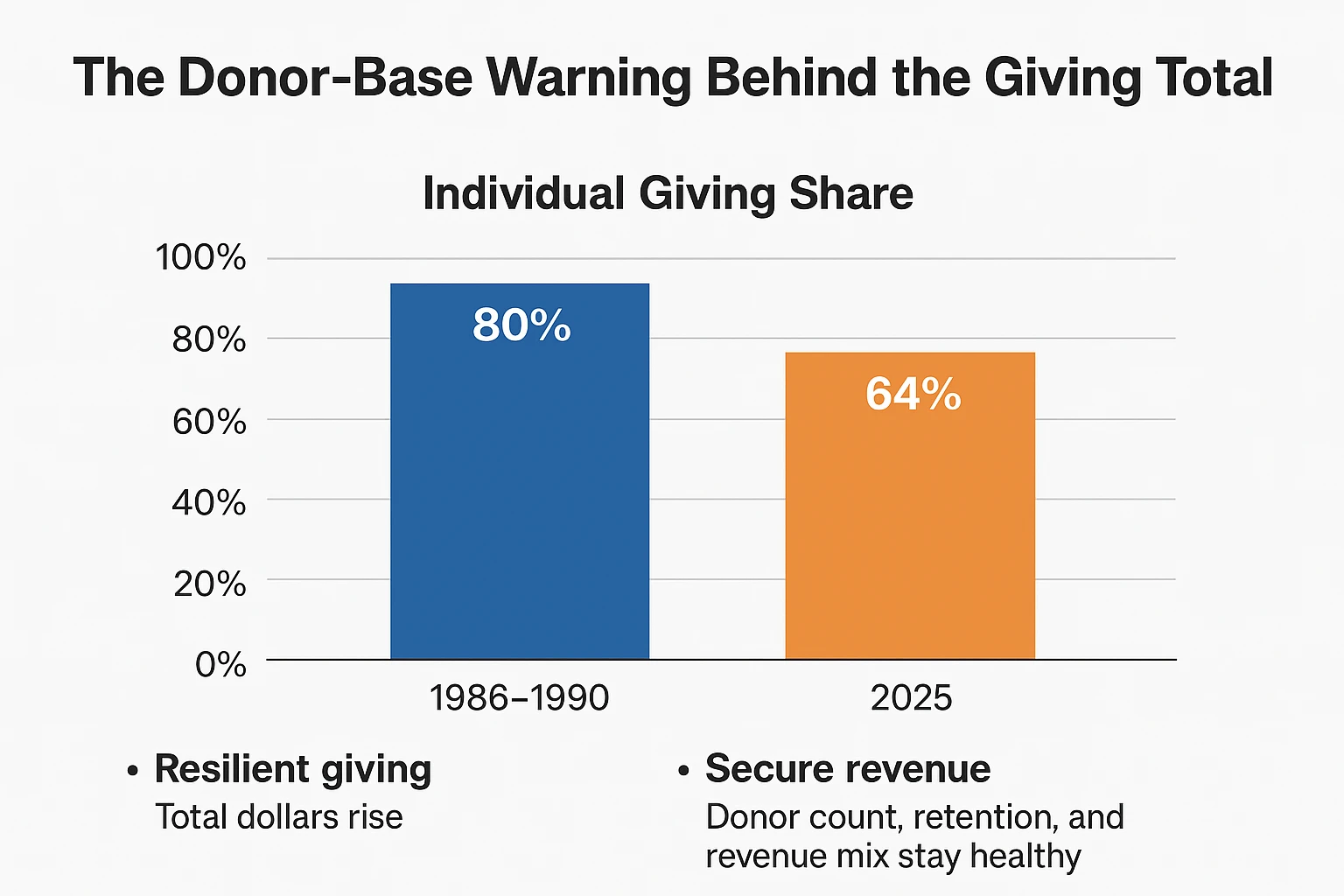
| Resilient giving | Secure revenue |
|---|---|
| Total dollars rise | Donor count, retention, and revenue mix stay healthy |
| Large gifts can lift results | No single donor or funder can derail the budget |
Track:
- Active donor count
- Second-gift rate
- Revenue share from top donors
A strong annual total is not proof of stability. Build many trusted donor relationships before the next budget shock.
Also Read: Latest Innovations in Donor Engagement from 2026 Headlines
Retention and Monthly Giving Move to the Center of Revenue Protection
Make the Second Gift the Immediate Objective
Donor counts fell 3.6% in 2025, while overall retention reached 43.3%. FEP data shows first-to-second-gift conversion remains the weak point.
- Thank donors within 48 hours.
- Send one impact update before the next ask.
- Ask for a second gift tied to one clear, near-term need.
Treat the first gift as the start of a relationship, not a completed transaction.

Use Monthly Giving as a Stability Mechanism
Offer monthly giving at checkout and in the first thank-you message. A small, clear monthly option can smooth cash flow and keep supporters close to the mission.
| Moment | Best prompt |
|---|---|
| First gift | “Make this support monthly” |
| Thank-you | “See what your monthly gift sustains” |
- Test two monthly amounts.
- Let donors skip or cancel easily.
- Share regular proof of impact.
Also Read: Resources – Cherian Koshy
Build Revenue Depth Through Mid-Level, Planned, and DAF Giving
Give Mid-Level Donors a Deliberate Path
Set a clear upgrade path for donors who give steadily but receive only mass appeals.
- Flag repeat donors with capacity or strong engagement.
- Offer a named giving circle and one personal contact.
- Show a specific next gift, tied to one result.
| Donor signal | Next action |
|---|---|
| Three gifts in 12 months | Invite a short discovery call |
| Event attendance | Share a focused impact offer |
Ask for commitment, not just a larger one-time gift.
Prepare for DAF and Planned-Gift Decisions
Make DAF and legacy giving easy to start. The IRS notes that DAF sponsors hold legal control while donors retain advisory privileges over grants. IRS guidance
- Add DAF instructions to your gift page.
- Offer bequest wording and refer tax questions to advisors.
- Thank DAF donors quickly, even when details are limited.
Also Read: Fundraising Strategies Comparison: Annual Campaigns vs Major Gifts
Turn Revenue Protection Into a Management System
Track Leading Indicators Before Revenue Falls
Review a simple dashboard every month, not only after a missed goal. Track:
| Signal | Watch for | Act when |
|---|---|---|
| Donor retention | Fewer repeat gifts | It drops for two months |
| Gift pipeline | Fewer qualified asks | Next-quarter coverage thins |
| Grant status | Delays or changed terms | A key award slips |
Urban Institute research found one in three nonprofits faced government funding disruption in early 2025. Assign an owner and a response date to every red signal.
Protecting revenue starts before the budget gap appears.
Diversify Without Abandoning Acquisition
Keep bringing in new donors, but fund retention first. Build a mix of recurring gifts, major donors, grants, earned income, and corporate support.
- Set a maximum share for any one source.
- Create a renewal plan for each major funder.
- Test one new acquisition channel per quarter.
| Priority | Purpose |
|---|---|
| Retention | Stabilize current income |
| Acquisition | Replace normal donor loss |

Protect donor trust before revenue gaps grow. Work with Cherian Koshy to build giving experiences that inspire steady, lasting support.
Frequently Asked Questions
Q1: How are nonprofits protecting revenue amid 2026 pressures?
They track donor retention weekly, renew monthly donors early, diversify funding, and keep a cash reserve. Clear impact updates also reduce doubt before supporters cut discretionary gifts.
Q2: Which revenue source needs attention first?
Start with existing donors. A modest retention gain often costs less than finding new supporters and creates steadier income.
Q3: How can leaders spot revenue risk early?
Watch gift frequency, renewal rates, grant timelines, and event registrations. Set trigger points that prompt outreach before a shortfall grows.
Conclusion
Protect revenue by tracking risk early, retaining everyday donors, diversifying income, and keeping reserves. CEP research confirms funding pressure remains real.


