

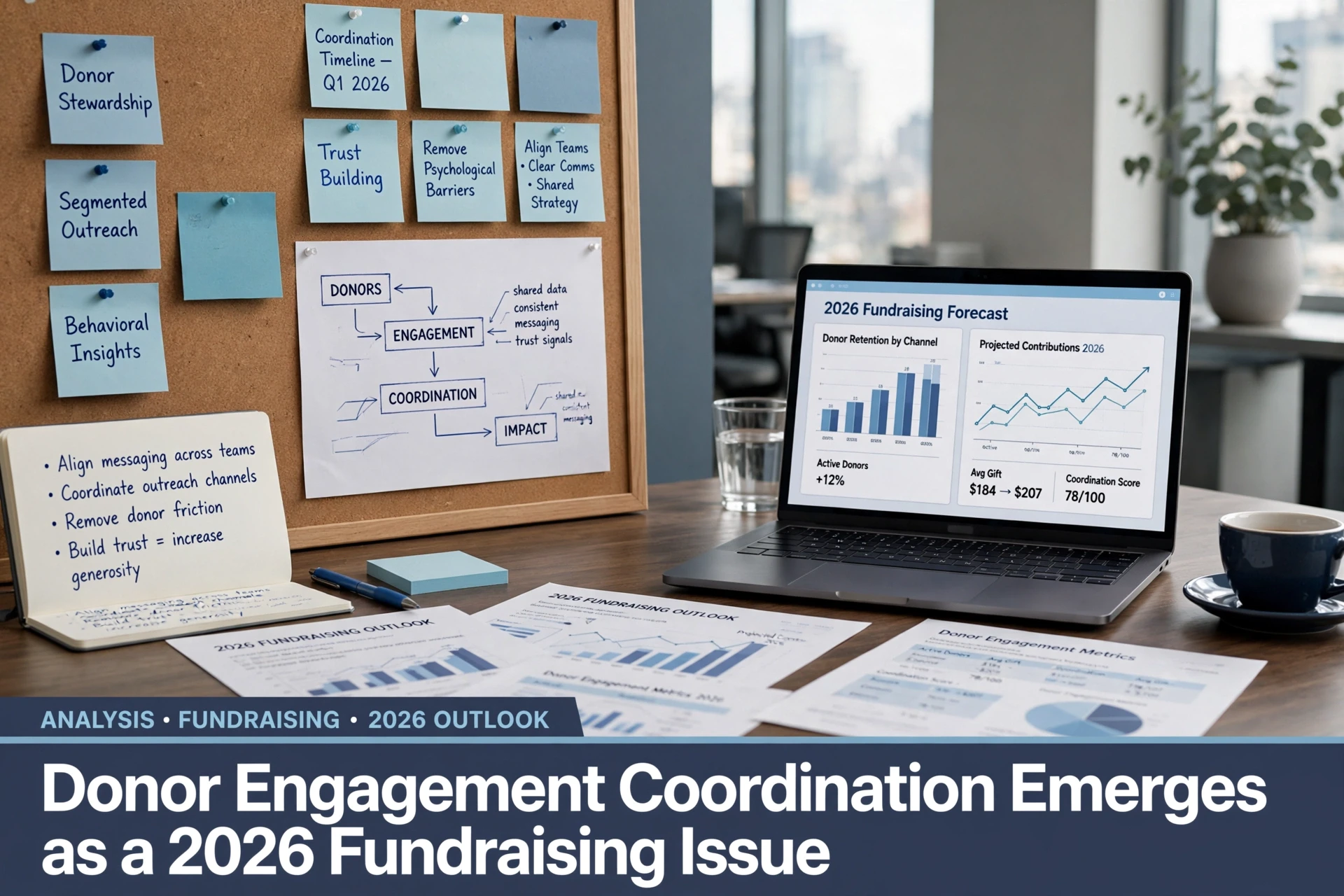
Quick Summary: New 2026 data shows giving grew 5.0% while donor counts fell 3.6%, with first-year retention stuck at 18%, so coordinating donor touchpoints across channels is now a critical operational issue. The article recommends assigning each new donor a single owner within 48 hours, sending fast personal thank-yous, and sequencing follow-ups across channels rather than stacking them. It notes that 79% of donors give more when contacted through their preferred channel, but cautions that broad survey patterns should be tested locally before reorganizing.
New 2026 data give donor engagement coordination real urgency: the Association of Fundraising Professionals reported giving rose 5.0% in 2025 while donors fell 3.6%, and retention sits at 43.3%. More money from fewer people. When fundraising, marketing, and stewardship work in silos, follow-up suffers – and first-time donors slip away. The numbers raise the stakes for coordinated donor experiences, though they don’t prove coordination causes retention. That’s the line this article walks, with behavioral science guiding what to test.
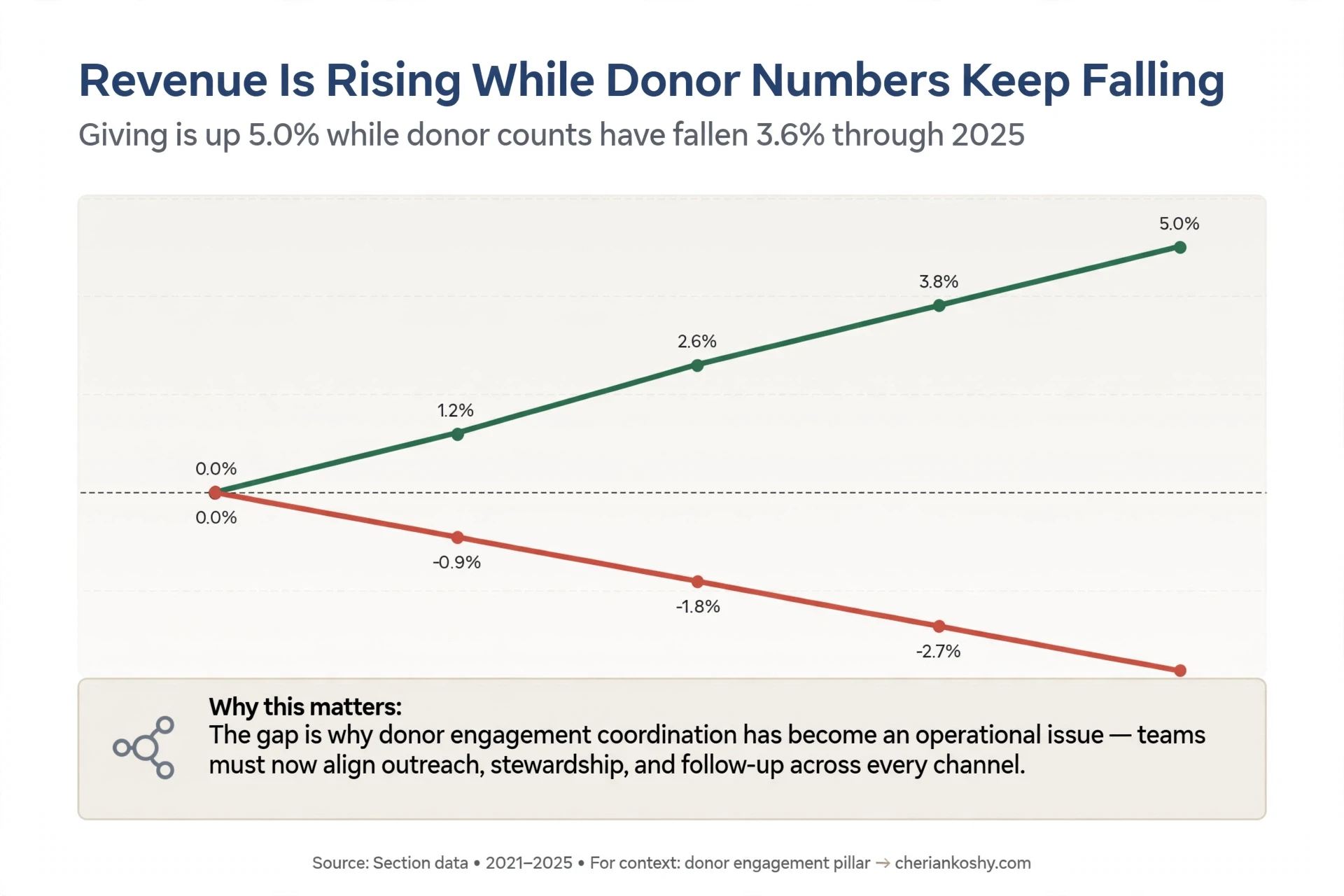
Revenue Is Rising While Donor Numbers Keep Falling
Here is the paradox at the center of 2026 fundraising. Charitable giving grew 5.0% in 2025, the strongest growth in five years. Yet donor counts fell 3.6%, the fifth straight year of decline, according to AFP’s Fundraising Effectiveness Project.
The growth came almost entirely from Major and Supersize gifts. Small and micro donors kept leaving. New donor retention stayed flat. Converting a first gift into a second remains the sector’s unsolved problem.
So revenue looks healthy while the base underneath it erodes. That gap is why donor engagement coordination has become an operational issue, not just a marketing one – teams must align outreach, stewardship, and follow-up across every channel. For context on the full engagement picture, see the donor engagement pillar.
Also Read: Resources – Cherian Koshy
First-Year Retention Is the Pressure Point
The 2026 Fundraising Effectiveness Project data confirms it: first-to-second gift conversion remains the sector’s weakest link. Retention sits flat at 18.0% year to date, and Virtuous’s benchmark report found three out of four first-time donors never gave a second gift.
The first 30 to 60 days decide the outcome. That’s where coordination matters.
The First Gift Needs a Coordinated Follow-Up
Most nonprofits already do the right pieces. They just do them separately.
- Marketing sends a welcome email series.
- The gift officer plans a thank-you call.
- The database team sets a renewal reminder.
Nobody owns the sequence, so the donor gets three disconnected touches and no relationship. Fix it with one rule:
- Assign each new donor a single owner within 48 hours.
- Send a personal thank-you within days, not weeks.
- Make the second ask within 90 days, tied to a specific result.
Behavioral science backs the sequence: donors feel seen when contact is fast, personal, and specific. As Cherian Koshy often notes, generosity follows trust, and trust follows being remembered.
Also Read: 8 Ways to Thank Donors on Social Media
Coordination Means Connecting Donor Touchpoints
Donors don’t experience channels. They experience one organization.
That’s the core of the coordination problem. Your email team, your mail shop, and your events staff may each do great work. If they don’t share timing and data, the donor sees noise. Research on donor behavior shows the average supporter needs 7 to 10 touchpoints across channels before giving or renewing, and single-channel donors give far less than multi-channel ones.
Coordination fixes this with three moves:
- Map every touchpoint. List where donors hear from you: email, mail, texts, events, phone.
- Assign each channel a job. Mail tells stories. Email drives action. Text reminds.
- Sequence, don’t stack. A mail piece on day 5 should build on the day 1 email, not repeat it.

As AGP’s omnichannel framework puts it, each touchpoint should reinforce the next. That’s the difference between multichannel and omnichannel. Consistency beats channel count, so start with two or three connected channels and grow from there.
Also Read: Behavioral Science for Donor Nurturing: A Practical Review
What Fundraising Teams Should Review Next
How Teams Can Audit the Donor Journey
Start with a simple map. List every point where a donor touches your organization: first gift, thank-you, first follow-up, renewal ask. Then check three things:
- Speed. Do thank-yous go out within 48 hours?
- Clarity. Does each message tell donors exactly what their gift did?
- Channel fit. Most donors prefer email, yet many teams lead with social media.
The 2026 Giving Signals Report found 79% of donors give more when contacted through their preferred channel. Fix that first. It costs nothing.
What the 2026 Evidence Can and Cannot Show
The CCS Philanthropy Pulse surveys 618 organizations, so results show broad patterns, not guarantees. Your donors may differ. Test locally before you reorganize.
Also Read: Latest Innovations in Donor Engagement from 2026 Headlines
Coordination gaps cost real donor trust. Bring in Cherian Koshy for a keynote or workshop to align your team and engage donors better.
Frequently Asked Questions
Q1: Why is donor engagement coordination a 2026 fundraising issue?
Donors now touch nonprofits across email, events, and texts. Without coordination, messages clash and trust drops, hurting retention.
Q2: Where should a small team start?
Map every donor touchpoint, then assign one owner per channel.
Q3: How does behavioral science help?
It removes friction and doubt, so supporters give more willingly.
Conclusion
Donor engagement coordination is now a core fundraising issue. Acquisition is up, retention is shaky: 2026 benchmark data shows new-donor retention near 24%, and CCS surveying names retention a top challenge. Coordinated, specific engagement closes that gap.


