


Quick Summary: In Q1 2026, charitable dollars increased by 4.3% despite a 0.8% drop in donors, mainly driven by larger gifts from existing donors. Micro-donors continue to decline, raising concerns about long-term growth, as retention remains flat and new donor acquisition weakens. Nonprofits should focus on improving second-gift strategies and donor segmentation to sustain growth.
Q1 2026 FEP data shows Fewer Donors but more money: charitable dollars rose 4.3% while donor counts fell 0.8%. That gap matters. Fewer Donors can hide behind solid revenue, raising risk if giving concentrates among bigger donors. This review breaks down Charity Dollar Trends, retention, methodology shifts, and signs of Funding Decline. We track FEP data closely because Fewer Donors is now the core growth problem.
Why Q1 2026 Still Shows More Money From Fewer Donors
The split is clear in the latest AFP summary of Q1 2026 FEP data: charitable dollars rose 4.3%, while donor counts still fell 0.8% year over year. That donor drop was better than the 2.3% decline a year earlier, but it still means revenue is rising faster than participation. Growth also came from every segment except Micro donors.
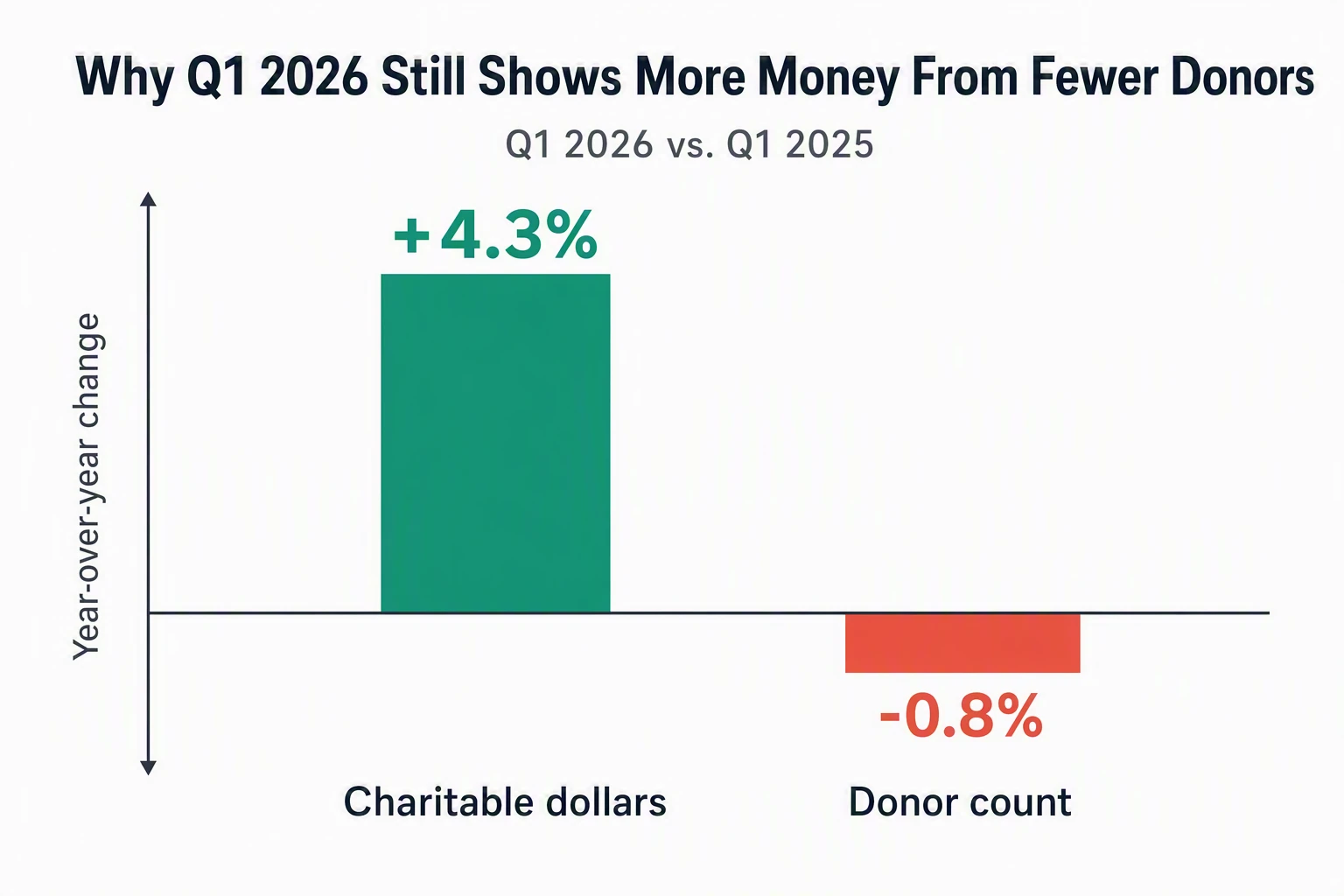
This is not a full recovery. It is a narrower base giving more. The Q1 2026 FEP dashboard says retention held flat at 18.0%, while new donor counts kept falling. That matters because existing donors can lift short-term revenue, but weak first-to-second gift conversion makes long-term growth fragile.
Also Read: 3 Tips for Winning the Attention Economy in Nonprofit Campaigns – Cherian Koshy
Where the Growth Is Coming From: Bigger Gifts, Weaker Micro-Donor Participation
The Q1 2026 pattern is clear. Money is up, but broad participation is still soft. That matters because growth from a narrow group is harder to trust over time.
[IMAGE_PLACEHOLDER: donor size giving comparison chart]Micro donors remain the weak point. FEP says Micro donors ($1-$100) were the only size group still shrinking in Q1 2026, even while other segments improved according to AFP’s Q1 2026 summary. If your file depends on first-time, low-dollar gifts, this is the warning sign to watch.
Large gifts are carrying the sector. In the FEP donor-size breakdown, Major and Supersize donors produced 74.4% of all dollars in Q1 2026, while making up just 2.3% of donors in the quarterly dollars data. That is good news for cash flow, but risky if your pipeline under those donors is thin.
New donor dollars are still under pressure. The topline donor drop was only 0.8%, but FEP says the improvement came from existing donors, while new donor counts kept falling. So the fix is not just better appeals. It is better second-gift strategy:
- thank fast
- offer monthly giving early
- show one clear outcome
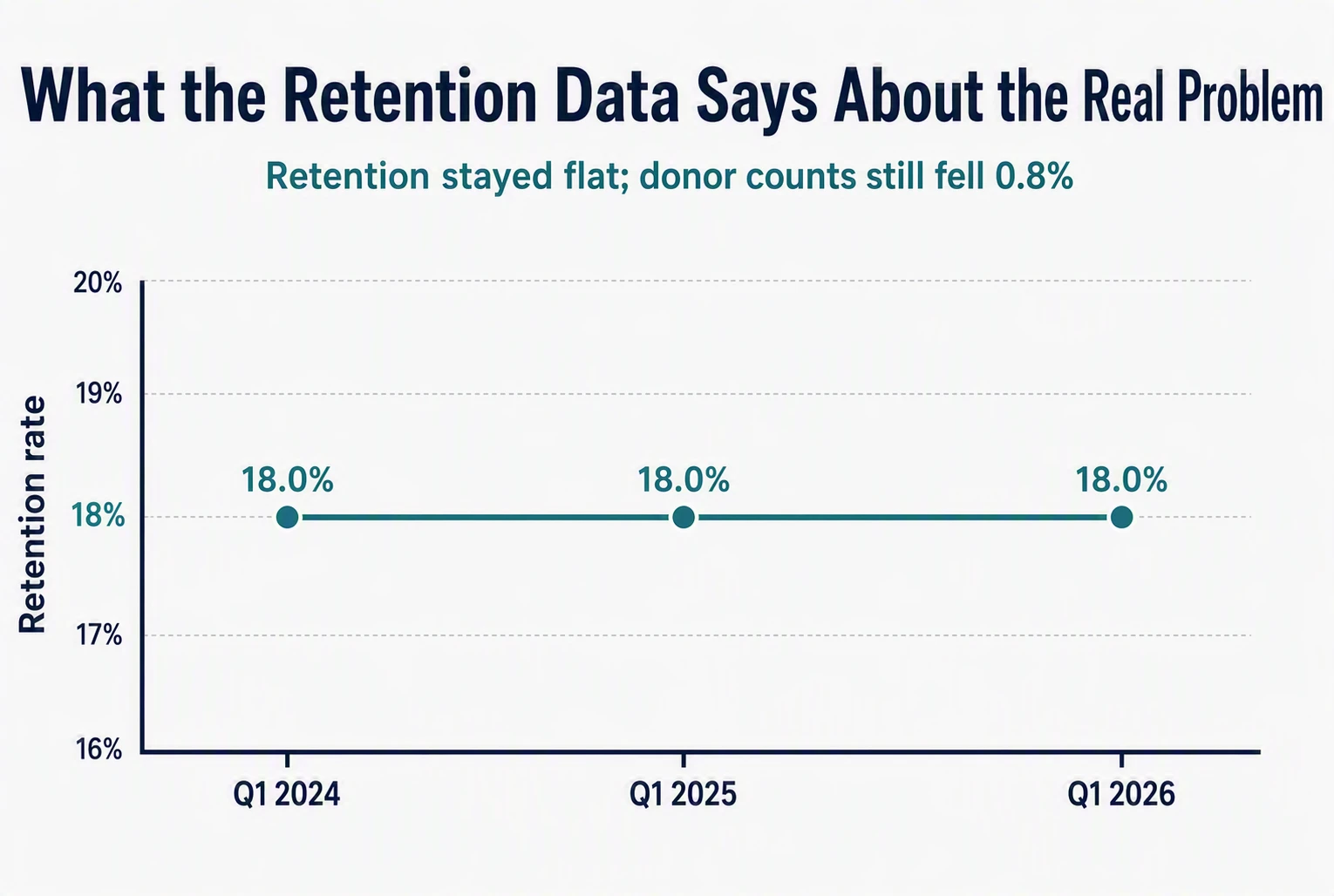
What the Retention Data Says About the Real Problem
Retention is steady, but not enough. Q1 2026 retention held flat at 18.0%, which sounds stable, but it does not fix the deeper leak. The FEP summary says donor counts still fell 0.8%, and the bigger issue is weak first-to-second gift conversion, not a broad retention rebound according to AFP’s Q1 2026 release.
The strategic implication for nonprofits is simple:
- Keep stewarding current donors
- Fix the new-donor handoff fast
- Push monthly giving early
- Build a second-gift plan within 30 days.
- Segment micro and first-time donors separately.
- Measure conversion, not just retention.
Stable retention can hide a weak pipeline. If new donors do not return, future revenue gets thinner even when dollars rise in the live FEP dashboard.
How the New FEP Methodology Changes the Reading
The Q1 2026 FEP report is not just a new quarter. It uses FEP’s biggest method update in five years. According to AFP’s Q1 2026 summary, FEP refined how it builds the panel, adjusts for late data, weights results, and groups organizations. The FEP methodology page says the panel is now rebuilt every quarter, late gifts get an equal reporting window, and weighting now leans on cause area using 2023 IRS Form 990 data.
Read this quarter as more comparable and more cautious, not as a clean continuation of older tables.
Turn fewer donors into stronger retention and better first-gift conversion with Cherian Koshy. Book a workshop or strategy session to remove giving barriers and grow loyal support.
Frequently Asked Questions
Q1: What do Q1 2026 FEP data reveal about changes in donor participation and giving trends?
Fewer people gave, but total dollars rose. Large gifts helped offset weak donor counts. The biggest pressure sits at the low-dollar end, where small and first-time donors continue to drop.
Q2: How can nonprofit organizations adapt fundraising strategies with fewer donors but larger donations in 2026?
Focus on two tracks:
- protect mid and major donors
- rebuild entry-level giving
Use faster follow-up, clearer impact proof, and a simple second-gift plan within 30 to 60 days.
Q3: What are the key donor retention strategies nonprofits should implement based on the latest FEP insights?
Keep it practical:
- thank fast
- report impact early
- ask again with a specific purpose
- segment by first gift and channel
- watch second-gift rate more than open rates
Retention starts with the second gift, not the first donation.
Conclusion
Q1 2026 is clear: nonprofits raised more money, but from fewer people. AFP’s FEP summary shows donor counts still fell as dollars grew, while the FEP dashboard points to weak new-donor conversion as the main risk.


