

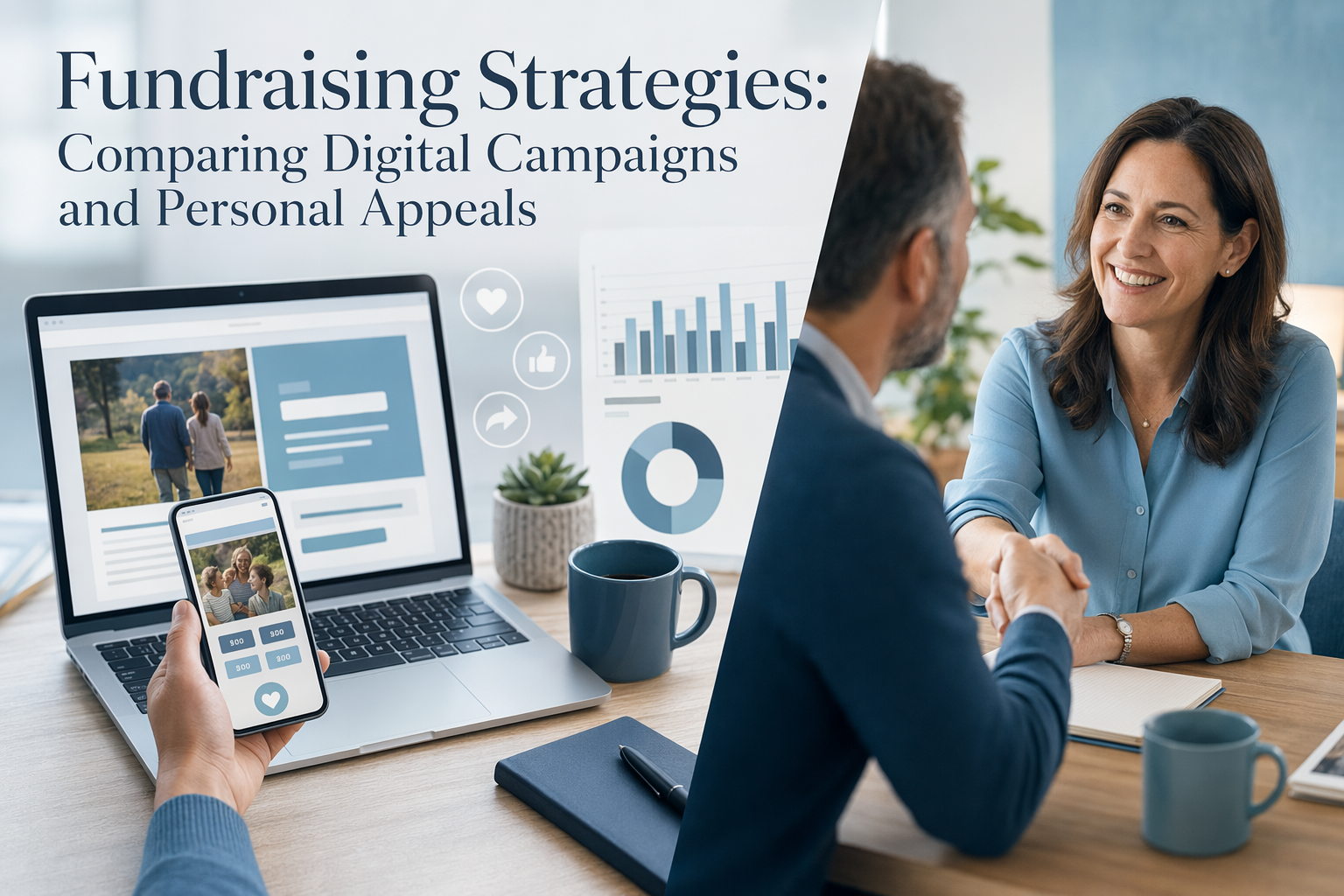
Quick Summary: Digital fundraising campaigns are great for reaching lots of donors quickly and cost-effectively, especially for acquisition and recurring gifts. Personal appeals build stronger trust and are better suited for major gifts, renewals, and deepening relationships. The most effective strategy combines both: start with digital to capture interest, then follow up with personal contact to deepen commitment.
Most teams see Digital Fundraising Campaigns pull ahead on speed and reach. Personal Fundraising Appeals win when trust, identity, or a big gift drives the choice. With tight budgets and weak retention, that tradeoff matters. This comparison uses tested fundraising practice and Fundraising Neuroscience to show where Digital Fundraising Campaigns work best, where Personal Fundraising Appeals matter more, and how to pair Digital Fundraising Campaigns in the right donor sequence.
Digital Fundraising Campaigns vs Personal Fundraising Appeals: At a Glance
| Digital Fundraising Campaigns | Personal Fundraising Appeals | |
|---|---|---|
| Reach | High-volume, scalable, global | Limited but focused |
| Personalization | Segmented and data-driven | Very high |
| Speed to launch | Fast | Slower |
| Donor trust | Strong when transparent and relevant | Very strong in relationship-led asks |
| Best use case | Awareness, acquisition, recurring giving | Major gifts, stewardship, renewal |
How Digital Fundraising Campaigns and Personal Fundraising Appeals Compare
Digital Fundraising Campaigns
Digital fundraising campaigns use email, social posts, landing pages, ads, and automation to reach many donors fast. They fit nonprofits that need broad awareness, donor acquisition, or recurring gifts with segmented, data-led messaging.
Personal Fundraising Appeals
Personal fundraising appeals focus on one-to-one or small-group asks shaped by a donor’s history and relationship to the cause. They suit teams pursuing major gifts, renewals, and deeper trust through direct human contact.
Where Donor Psychology Favors Each Approach
Personal appeals work best when the ask feels close, specific, and human. Donors give faster when the message matches how they process information. A 2021 study found donation intent rises when the appeal style fits the donor’s thinking style, whether emotional or analytical congruent processing styles research.
Digital campaigns win when relevance is clear at scale. They let you match story, timing, and channel to donor cues fast.
Relevance beats reach if your message feels generic.
When you need volume, digital helps. When you need trust, nuance, or a major gift, personal outreach usually beats it. Appeal design matters too. Research shows lower first ask amounts can raise response rates, while steeper ask ladders can lift gift size appeal scale study.
Which Converts Better for Acquisition, Retention, and Major Gifts?
Acquisition and list growth favor digital reach. Digital campaigns scale fast, test fast, and pull in more first gifts at lower effort per donor. That matters because the sector still needs volume at the top of the funnel. In 2025, donor counts fell 3.6% even as dollars rose, according to the Fundraising Effectiveness Project.

- Best for:
- New donor capture
- Email list growth
- Recurring gift entry points
Retention and upgrade paths favor relationship depth. Personal appeals win when the goal is a second gift, larger commitment, or major gift move. FEP reports overall retention at 43.3%, with growth driven mostly by major and supersize donors in 2025, shown in the Quarterly FEP Report.
Use digital to start the relationship. Use personal outreach to deepen it.
How to Blend Both Into One Smarter Fundraising System
Start with digital, then shift to human contact fast. That matches the sector’s biggest gap: new donor retention still stays flat, while donors who stay give more often and more generously according to 2026 benchmark data.
- Run a digital campaign to capture intent.
- Thank donors within 48 hours.
- Flag strong signals like repeat clicks or larger gifts.
- Move those donors into a personal call, note, or visit.
Use digital for scale and personal outreach for trust.

Which Should You Choose for Your Next Campaign?
Choose digital when you need speed, scale, or many small gifts fast. Choose personal appeals when you need larger gifts, renewals, or second gifts. That fits 2026 data: online revenue rose, but new online donor retention stayed weak, while donors who stay give more and more often, according to M+R reporting and Virtuous benchmark data. > Best move: use digital to acquire, then follow with a personal ask to keep donors.
Get sharper donor response with Cherian Koshy – learn how behavioral science can improve digital campaigns and personal appeals.
Frequently Asked Questions
Q1: How do digital campaigns compare to personal appeals in nonprofit fundraising effectiveness?
Digital campaigns scale faster and cost less per touch. Personal appeals usually win for major gifts, renewals, and complex asks because trust, emotion, and memory are stronger in one-to-one moments.
Q2: What are the most effective digital fundraising strategies for nonprofits in 2026?
Use tight audience segments, short mobile-first donation pages, strong email follow-up, retargeting, and clear impact proof. Match the ask to donor warmth. Cold traffic needs education. Warm donors need urgency and relevance.
Q3: How can nonprofit organizations leverage AI and behavioral science to increase donations?
Use AI to predict timing, message fit, and likely upgrade paths. Use behavioral science to reduce friction, frame impact clearly, and reinforce identity. Cherian Koshy stands out by tying these ideas to donor trust.
Conclusion
Digital campaigns scale reach. Personal appeals deepen trust. The best mix depends on goal, donor stage, and message fit. Research shows impact clarity and specific details lift giving and repeat support meta-review findings and repeat-donation evidence.


