


Quick Summary: Nonprofits should diversify revenue sources to avoid overreliance on a few big donors or grants. Building a small, manageable mix of channels like recurring giving, email appeals, and events helps sustain steady growth. Effective stewardship and segmentation are key to retaining donors and increasing giving over time. Before expanding, measure retention, response rates, and costs to ensure your team can handle the growth without losing trust.
A nonprofit that leans on one gala, one grant, or one major donor can hit a crisis fast when that money slips. This guide fixes that core risk in Nonprofit Fundraising. You will learn how to choose Fundraising Strategies, spread revenue across channels, and build Effective Fundraising systems your team can actually run. I focus on practical Nonprofit Fundraising decisions that balance growth, trust, and staff time, so Nonprofit Fundraising stays steady under pressure.
1. Map Your Current Revenue Concentration
List every revenue stream from the last 12 months, then rank each by share. Include major gifts, monthly giving, grants, events, corporate support, and DAFs. If one source covers too much of the budget, flag it. The Fundraising Effectiveness Project says 2025 giving grew 5.0% while donor counts fell 3.6%, which signals heavier reliance on fewer donors AFP data.
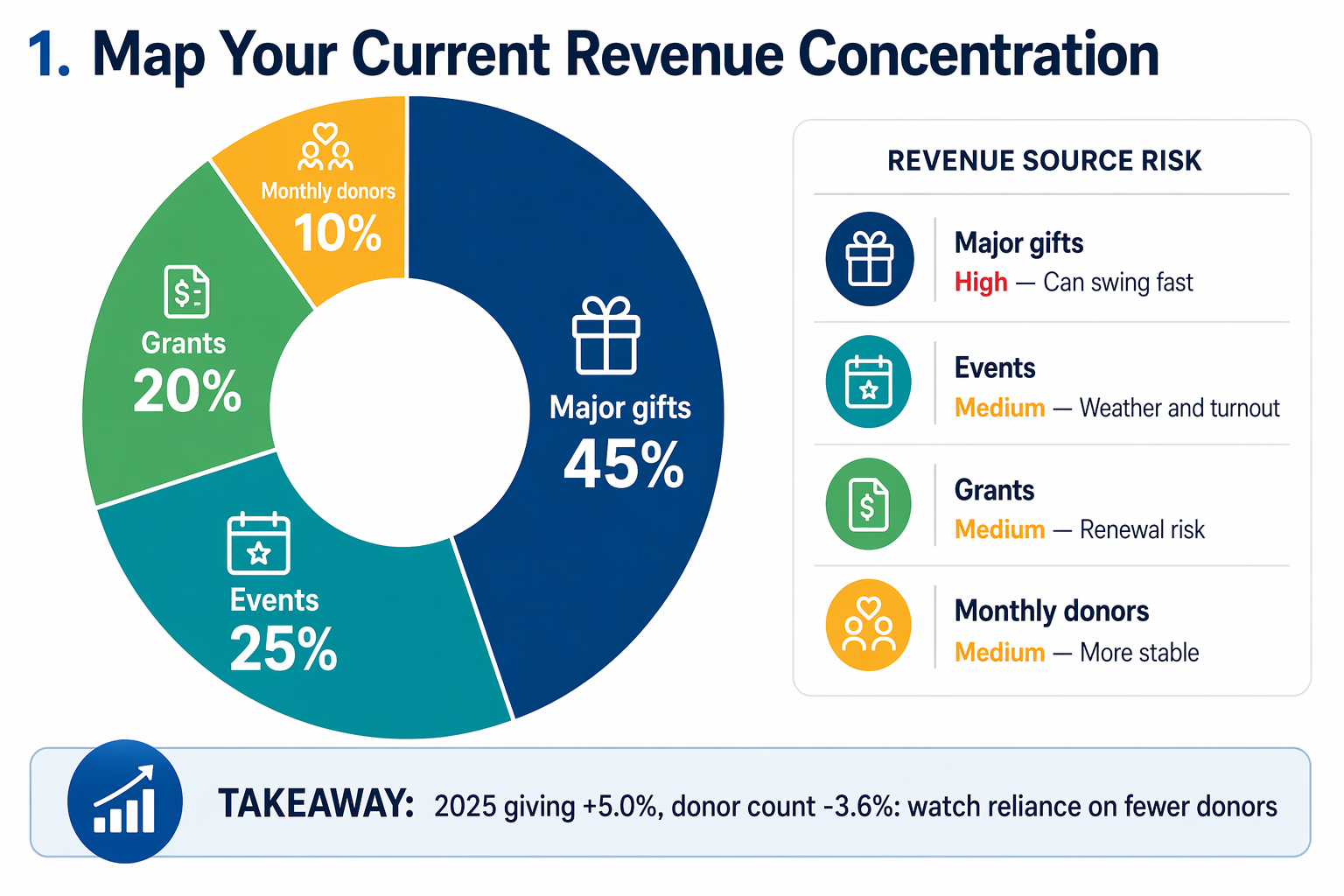
Use a simple table to see where risk sits:
| Source | % of revenue | Risk note |
|---|---|---|
| Major gifts | High | Can swing fast |
| Monthly donors | Medium | More stable |
| Grants | Medium | Renewal risk |
Check donor file trends, not just totals. M+R found monthly giving made up 27% of online revenue in 2025 M+R Benchmarks.
Stability often hides in repeat, lower-drama revenue.
2. Build a Core Channel Mix That Can Compound
Start with recurring individual giving. It gives you steady cash flow and stronger retention. The Fundraising Effectiveness Project says donor counts fell 3.6% in 2025 even as dollars rose, so a broad base matters more now according to AFP. GivingTuesday also found monthly donors have higher annual value than non-recurring donors in its 2026 research.

Add one or two complementary channels, not everything at once:
- Email appeals for low-cost repeat asks
- Peer-to-peer or events for reach and new names
- Major donor outreach if you already have warm prospects
Keep the mix small enough that your team can run it well every month.
Design each channel to feed the others:
- Use events to capture first-time donors.
- Move them into email welcome and impact updates.
- Ask loyal donors to join monthly giving.
- Flag strong responders for personal outreach.
For the bigger framework, link this back to the parent guide: Beginner’s Guide to Effective Nonprofit Fundraising Techniques.
3. Protect Growth With Stewardship and Segmentation
Growth slips when donors feel generic. AFP notes first-time donor retention stays near 19% and overall retention remains in the low-to-mid 40s, so your best move is to keep more of the people you already reached through donor stewardship data from AFP.
- Segment by intent, not just amount:
- First-time crisis givers
- Monthly sustainers
- Event-only supporters
- Mission loyalists
- Track what sparked the gift, preferred channel, and next likely action.
- Match stewardship to channel:
- Email donor – fast thank-you, one impact update
- Event donor – photo recap, story, soft next step
- Major donor – personal note, short report, call
- The Fundraising Effectiveness Project shows 2025 dollars rose 5.0% while donors fell 3.6%, according to the latest FEP report.
Send fewer, more relevant touches. Relevance builds trust faster than volume.
4. Know What to Measure Before You Expand Again
Use a short scorecard before adding a new channel. Track:
- Donor retention
- First-to-second gift rate
- Recurring donor churn
- Net revenue after direct costs
- Time to thank and follow up
The Fundraising Effectiveness Project found donor counts fell 3.6% in 2025 even as dollars rose, and overall retention only edged up to 43.3%, according to the AFP summary.
Expand only when stewardship can keep up. If thank-yous lag, reports slip, or monthly donors are not getting care, pause. More volume without follow-up usually means weaker trust, lower renewal, and a shakier base. > Growth is healthy only when donor experience stays strong.
Ready to build a fundraising plan your team can actually run? Work with Cherian Koshy to remove donor friction, build trust, and turn scattered tactics into a clear, resilient growth system.
Frequently Asked Questions
Q1: What are the essential components of a successful nonprofit fundraising strategy?
Clear goals, a strong case for support, donor segments, channel mix, follow-up plans, and simple metrics.
Q2: How do nonprofits effectively diversify fundraising channels for long-term stability?
Start with two to three channels that fit staff time, budget, and donor habits, then test before expanding.
Q3: What are best practices for building donor relationships using neuroscience insights?
Use specific stories, lower friction, show social proof, thank fast, and make giving feel safe and meaningful.
Conclusion
Effective nonprofit fundraising starts with channel fit, clear sequencing, and steady follow-up. Giving is still growing, with U.S. charitable giving topping $617.2 billion in 2025, but fewer donors are giving, according to the Fundraising Effectiveness Project.


