

Quick Summary: Belonging fundraising now has hard evidence behind it, with a 2025 meta-analysis of 89,570 people finding a medium link (r = .29) between social identification and giving, strongest when donors identify with fundraisers. Stewardship that makes donors feel seen, like specific thank-yous and impact updates, turns belonging into repeat gifts, but the effect is contextual and varies by culture. Fundraisers should A/B test one belonging cue at a time, measure actual gifts and unsubscribes, and avoid false exclusivity or fake social proof to keep trust intact.
Belonging fundraising is becoming a testable behavioral tool, not just warm language. A 2025 meta-analysis of 109 effect sizes and 89,570 people found a medium link between social identification and giving. New work on stewardship and appeals points to recognition, shared experience, and psychological fit. Yet belonging fundraising can harm trust when it relies on false exclusivity or weak neuroscience claims. This analysis separates evidence from hype and shows ethical ways to test belonging fundraising.
The Evidence Has Shifted From Affinity to Identification
What the 2025 Meta-Analysis Found
Liking a cause is not the same as seeing it as part of who you are. A 2025 meta-analysis of 109 effects and 89,570 people found a medium link between social identification and giving, at r = .29. The study found the strongest link when people identified with fundraisers (r = .36), followed by beneficiaries (r = .24) and other donors (r = .23).
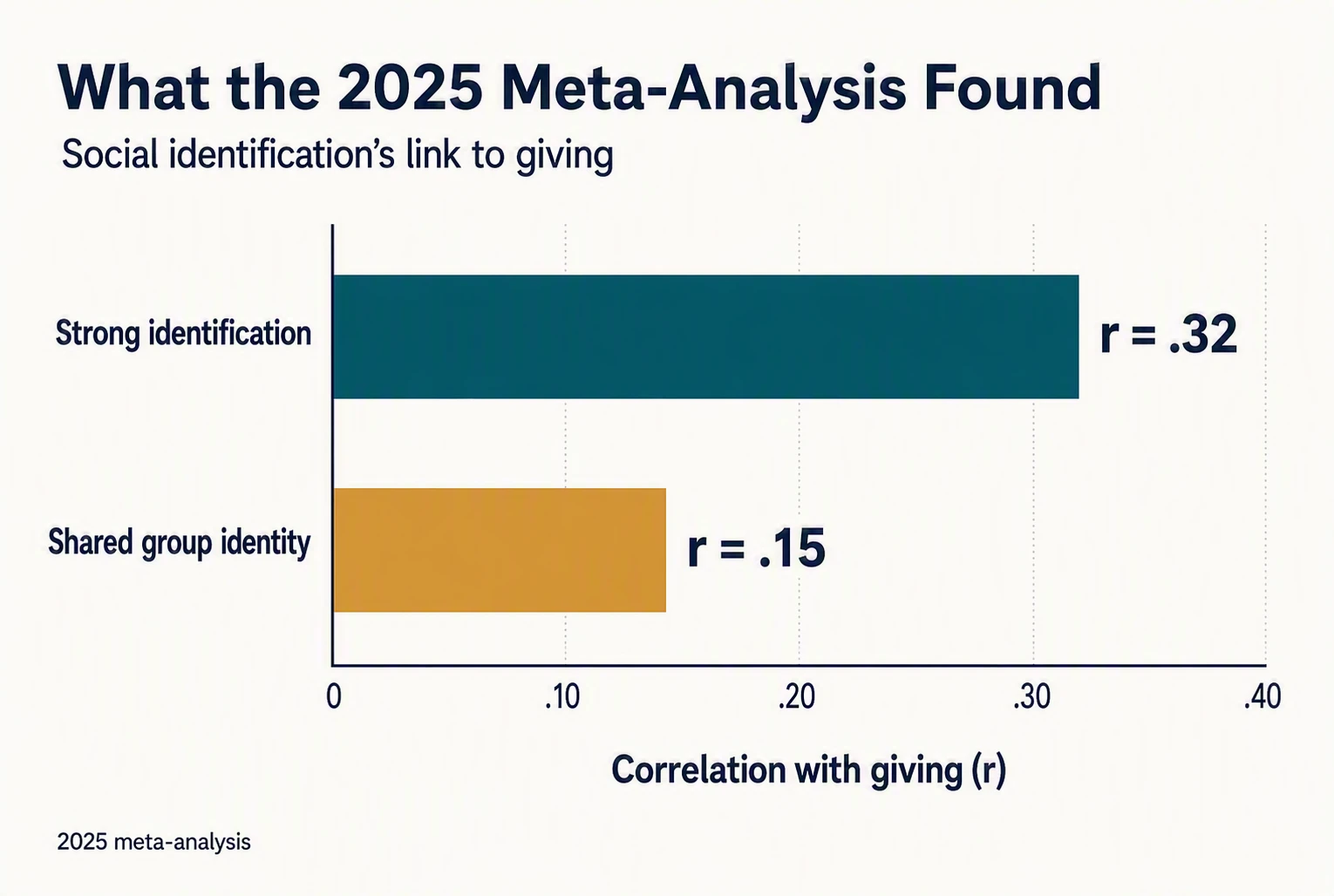
| Approach | Link to giving |
|---|---|
| Strong identification | r = .32 |
| Shared group identity | r = .15 |
Test messages that help supporters name their role in the work, not just admire it.
- Use real peer stories.
- Show shared values in action.
- Measure actual gifts, not stated intent.
Also Read: How Behavioral Science Can Transform Your Fundraising Results
How Stewardship Turns Belonging Into Donor Behavior
Recognition and Two-Way Engagement Matter
Stewardship works when donors feel seen as people, not payment records. Name the role they played, share a clear result, then ask what they want to hear about next.
A 2026 Give.org survey found that 49% of online giving platform users prefer connection and updates from the charities they support. The report makes the point clear: follow-up is part of the donor experience.
- Send a personal thank-you within 48 hours.
- Invite a reply with one simple question.
- Report back on the outcome, not just the activity.
| Stewardship act | Belonging signal |
|---|---|
| Specific thank-you | “You mattered here” |
| Reply invitation | “Your voice counts” |
| Impact update | “We did this together” |
Do not fake closeness. Let donors choose how often they hear from you.
Also Read: Articles – Cherian Koshy
The 2026 Research Adds a Critical Qualification
Belonging Is Contextual, Not One-Size-Fits-All
Belonging can increase giving, but the group and setting matter. A 2025 meta-analysis found stronger links when donors identify deeply with a fundraiser, beneficiary, or fellow supporters, rather than simply sharing a broad group label. The review covered 89,570 participants.

A 2026 cross-cultural study also found giving patterns differ by civic setting and culture. US giving was more individual, while Taiwanese giving was more socially rooted. Read the cross-cultural findings.
- Test identity cues with real donor groups.
- Invite participation without implying outsiders do not belong.
- Measure gifts, repeat giving, and unsubscribes.
Tip: Let supporters define the “we.” Do not force a shared identity through copy.
Also Read: Behavioral Science Tactics Are Reshaping Giving in 2026
What Fundraisers Should Test Next
Build a Measurement Framework
Test one belonging cue at a time. Compare a plain appeal with a version that names a shared group, shows donor impact, or invites a small act of participation. Research suggests that emotion works best when it fits the cause’s moral aim, such as compassion for care-focused work and gratitude for fairness-focused work (behavioral research summary).
| Test element | Version A | Version B | Primary measure |
|---|---|---|---|
| Email subject | “Help fund clean water” | “Join neighbors funding clean water” | Open rate |
| Donation page | Standard thank-you | Welcome into a donor community | Completion rate |
| Follow-up | Receipt only | Receipt plus shared progress | Second-gift rate |
- Set one clear hypothesis.
- Randomly split a similar audience.
- Track gifts, repeat gifts, and unsubscribes for 30 to 90 days.
- Keep the winning change only if it helps donors and results.
Ethics check: Never imply belonging depends on giving. Offer real participation, clear choice, and a respectful exit.
Build donor experiences that make people feel seen and included. Partner with Cherian Koshy to test ethical belonging-based fundraising.
Frequently Asked Questions
Q1: How is belonging shaping nonprofit fundraising in 2026?
Donors respond to clear proof that people like them are part of a shared cause. Show community, welcome new supporters, and thank them as members.
Q2: How can we test belonging messages?
Run a small A/B test. Compare a standard ask with one that names the donor’s role in a group.
Q3: What should we avoid?
Do not fake social proof or pressure donors. Belonging must feel earned, honest, and inclusive.
Conclusion
Belonging can make generosity feel shared, not pressured. Build donor experiences around real connection, choice, and impact. Research links social connection with stronger prosocial intent and action, as Greater Good reports.


